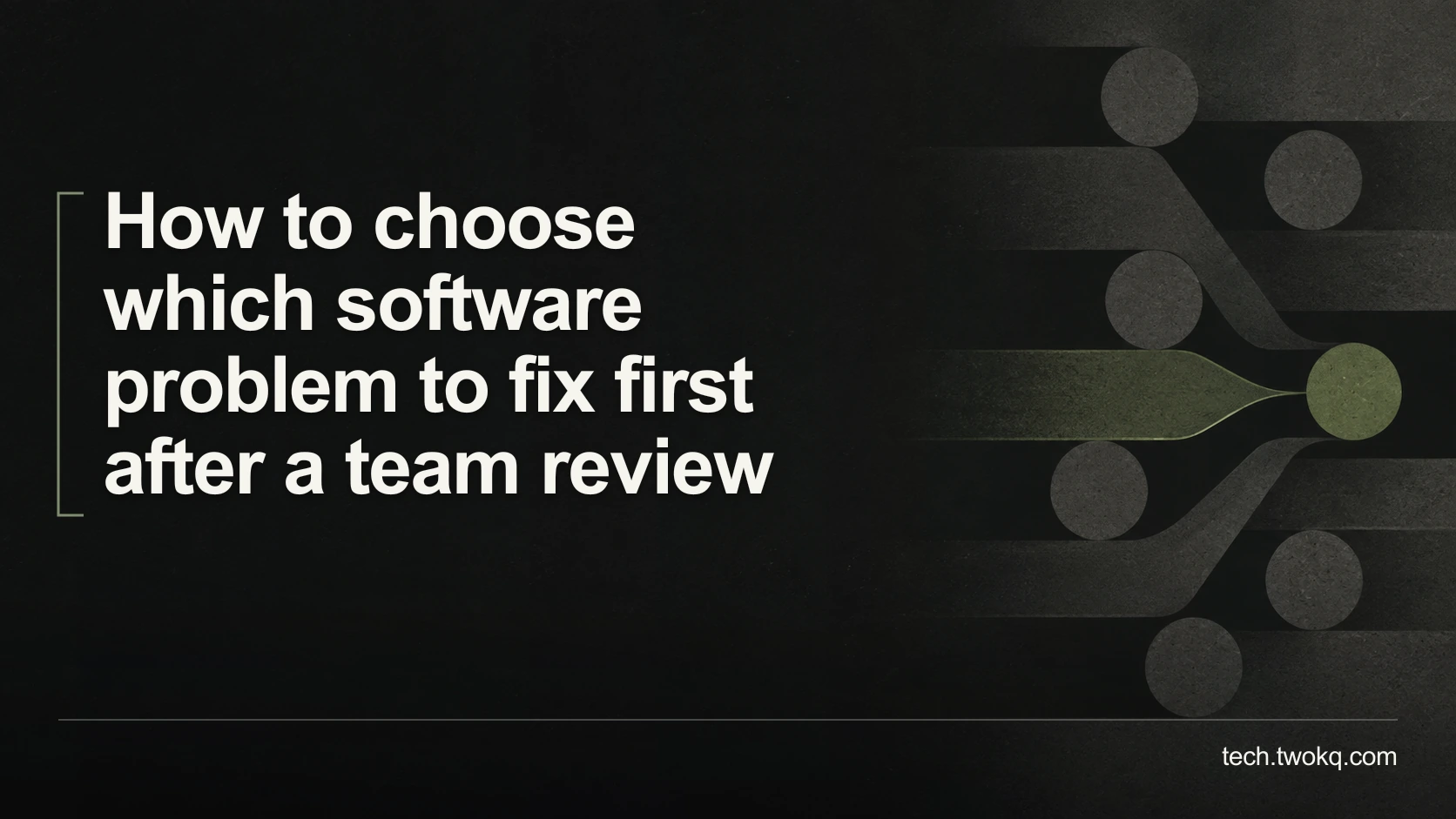
Turn a team review into a realistic change queue by separating urgent risks, evidenced problems and uncertain complaints, with time for testing and reversal.
Direct answer: Escalate credible security, legal or serious continuity concerns first, then choose an evidenced operational problem whose proposed change is authorised, testable and reversible. Prefer the change that removes an important recurring obstacle within the team's real capacity, not the complaint with the most votes. If the consequence is substantial but the cause remains unclear, prioritise a bounded investigation rather than pretending you already know the fix.
A retrospective can produce a long list of reasonable concerns and still leave the team less focused. Some items are symptoms, some are proposals, and others are urgent risks that should never have entered an ordinary improvement contest.
My recommendation is to schedule fewer changes and reserve explicit time to verify them. A team facing an active incident may need coordinated parallel action, but routine improvement should not imitate an emergency simply to make the review look productive.
Convert the review into a decision queue
Use The evidence-based change queue, an editorial method that separates escalation, investigation and implementation before ordering work. It uses consequence, recurrence, confidence and reversibility as reasons for a decision, not numbers multiplied into a supposedly objective score.
The parent guide, the technology retrospective for small teams, explains how to surface the real operating system and leave with a smaller change list. This article starts after those concerns have been collected and asks what should actually happen next.
Begin by rewriting each item as an observed problem. Replace “buy a better project tool” with the task that currently fails, such as “handover owners cannot locate the approved brief”. A proposed purchase is not evidence about its own necessity.
For every item, record an example, affected role, consequence and person able to provide more information. Avoid copying confidential customer material into the review notes. Link to an authorised record or describe a synthetic equivalent where that is enough.
Remove urgent risk from the popularity contest
An exposed account, possible unauthorised disclosure or inability to recover essential work deserves an appropriate escalation route. The review organiser should not decide legal reportability or incident severity by majority vote.
Name the accountable owner, preserve relevant evidence and use the organisation's incident or professional-advice process. Requirements vary by jurisdiction, sector and contract; a qualified local adviser should determine specific legal obligations where they arise.
The UK's National Cyber Security Centre recommends managing cyber risk in the context of organisational objectives and governance, rather than treating it as an isolated technical exercise. Its risk-management guidance supports that distinction. This article's queue is an editorial method, not an NCSC certification or replacement for incident management.
Do not make unapproved security changes in the name of reducing risk. A hurried removal of access or deletion of data can interrupt essential work and damage evidence. Follow authorised procedures.
Distinguish known obstacles from uncertain complaints
For the remaining operational problems, ask whether the team can demonstrate the failure. A reproducible error, repeated reconciliation task or clear missing ownership rule is stronger evidence than a prediction that a new product would be nicer.
Confidence should describe the evidence, not the confidence of the speaker. “Seen in four recent handovers and reproduced with a dummy project” is useful. “Everyone knows the platform is the problem” is not.
Where the consequence is clear but the cause is not, create an investigation item. Give it a question, a time allowance and an expected output. For example, establish whether delays occur before approval, during export or after delivery.
Stop an investigation when its agreed question is answered or the next step needs expertise or authority the team does not have. Do not let “research” become an indefinite holding area for avoiding a decision.
Judge the candidate changes on meaningful grounds
Consider the consequence of doing nothing, how often the failure affects actual work, and whether the proposed intervention addresses the observed mechanism. Frequency alone is not decisive: an occasional blocked payroll approval could matter more than a daily cosmetic annoyance.
Next, consider reversibility. A documented setting change in a test copy is different from deleting a shared account or migrating a live record system. The harder a change is to undo, the stronger the preparation and evidence should be.
| Queue item | Evidence required now | First action | Completion evidence |
|---|---|---|---|
| Credible serious risk | Enough detail for the responsible specialist to assess it | Escalate through the authorised route | An accountable response and agreed follow-up |
| Important problem with unclear cause | A concrete symptom and consequence | Run a bounded investigation | A supported explanation or a precise escalation question |
| Supported, reversible improvement | A demonstrated failure and plausible remedy | Trial the smallest authorised change | The task improves and the rollback remains usable |
The table separates work types rather than assigning universal priority scores. Within ordinary improvements, choose the most consequential well-supported item that can be tested properly with the people and time available.
Calculate capacity before promising changes
Consider a hypothetical team with eight issues from its review. Two are possible legal or security concerns requiring specialist escalation, three are understood problems with reversible candidate fixes, and three need more investigation. These are illustrative categories, not findings from a real organisation.
The team has six person-hours, or 360 person-minutes, available for this week's review follow-up. Assume ninety minutes are needed for escalation coordination and sixty for an initial investigation. That leaves 360 − 90 − 60 = 210 minutes for planned fixes and contingency.
Suppose the three candidate fixes require seventy, one hundred and one hundred and thirty minutes respectively. Each estimate includes preparation, implementation, verification and a short handover. Together they need 70 + 100 + 130 = 300 minutes.
The team cannot responsibly promise all three within 210 minutes. If the first two address the most important evidenced obstacles, scheduling them uses 70 + 100 = 170 minutes and leaves forty minutes for unexpected checks. The third remains queued with an owner and review date.
This arithmetic does not prove that the two shorter fixes deserve priority. If the 130-minute intervention addresses a greater consequence, it may replace one or both. Nor is forty minutes a universal contingency rule; it is simply the remainder in this example.
These are capacity allocations, not cash savings. A person who coordinates the escalations has done necessary work even if no interface change appears that week.
Define success and reversal before implementation
For the selected change, write a short acceptance statement using the original task. For example: “A colleague taking over the dummy project can identify the approved brief and current owner without contacting the original editor.”
Specify the baseline and the observation period. Do not claim success because nobody complained immediately after deployment. If the problem occurs at weekly handover, observe a comparable handover rather than only the first quiet afternoon.
Preserve the previous configuration or recoverable data before changing it. Name the person authorised to reverse the change and explain which result would trigger reversal. A rollback plan that depends on an unavailable account owner is not ready.
Give affected colleagues enough information to test and challenge the result. Include someone who uses a different device, an accessibility feature or a less common workflow when that difference could change the outcome.
If the change introduces new errors, extra manual checking or inappropriate access, stop expansion. Recover the previous arrangement where safe, record what failed and return the problem to investigation. A failed trial can improve the evidence without becoming a failed organisation-wide rollout.
Make the next review smaller and more useful
Keep deferred items visible with a reason and a next decision date. “Not this week because the migration needs an export test” is a useful status. “Low priority” without context invites the same argument at every meeting.
Remove resolved items only after the success condition has been observed. Retain a concise record of the change and its owner so a future colleague understands why the configuration exists.
Set up next week's work in forty-five minutes
- Use the first ten minutes to merge duplicate symptoms and identify any concerns that require immediate authorised escalation.
- Spend fifteen minutes separating remaining items into investigations and supported changes. Attach evidence and an accountable owner to each.
- Use ten minutes to allocate actual person-time, including testing, communication and recovery preparation.
- Spend the final ten minutes defining the first change's success condition, rollback and review date. Tell affected colleagues what will change and what evidence to report.
- At the agreed review, keep, reverse or investigate further based on the observed task. Stop adding changes if essential verification cannot fit into the available time.
Related guides
Frequently asked questions
Should we let everyone vote on the fixes?
Voting can reveal which frustrations are widely felt, but it should not determine the response to serious risk or replace evidence about consequences. A problem affecting one colleague may block an essential service, while a popular cosmetic change may have little operational value. Use votes as one input, then ask what work fails and who is affected. Explain the final decision in terms the team can inspect and challenge. If two low-risk changes have similar evidence, consequence and effort, preference can reasonably break the tie. Do not present that preference as a scientific ranking or a substitute for accountable ownership.
What if the founder insists on a different priority?
Ask the founder to state the business consequence or constraint behind the request, then add it to the same decision record. They may have information about a customer commitment or strategic dependency that the rest of the team lacks. If the reason is a preference, label it as such and make the trade-off visible: which investigation or verified fix will move out of the available capacity? Accountable leadership can choose differently, but the displaced work and risks should not disappear from view. Escalate unresolved legal or security concerns through the appropriate route rather than treating authority as evidence that those concerns are harmless.
Can a quick fix still deserve a full review?
Yes, when the consequence of getting it wrong is substantial. The number of clicks required to change a setting does not measure its impact on shared access, records or service continuity. Review who is affected, what can be recovered and whether you are authorised before treating the task as trivial. For a genuinely low-risk, reversible change, the review can be very short and proportionate. The aim is not paperwork for its own sake. It is to avoid confusing easy implementation with safe implementation, while ensuring that testing and communication do not consume more effort than the small improvement could reasonably justify.
How should we handle a problem nobody can reproduce?
Keep a narrowly defined observation task instead of dismissing the report or starting a speculative rebuild. Ask for the exact task, timestamp, environment and visible result when the problem next occurs, avoiding unnecessary sensitive details. Agree who will collect the evidence and when to review it. If the consequence is serious, involve qualified support even without a reproduction. If it is minor and rare, a bounded watch for the next relevant occurrence may be enough. Do not invent a root cause to satisfy the queue. The useful outcome is either clearer evidence, an appropriate escalation or a conscious decision to defer further work.
Should we prioritise changes with the largest estimated time saving?
Not automatically. A large estimate based on weak assumptions may be less useful than a modest, well-supported improvement to an essential task. Check whether the calculation includes setup, review, exceptions and ongoing maintenance, and whether the time would genuinely be released from the same people doing the work. Keep security, accessibility and continuity requirements visible even when they resist simple valuation. If two changes have comparable consequences and evidence, expected workload reduction is a sensible differentiator. Avoid describing time released as cash saved unless a corresponding expense actually disappears. The ranking should survive reasonable changes in uncertain assumptions rather than rely on a precise-looking total.
When should we stop improving the current tool and replace it?
Consider replacement when repeated evidence shows the existing arrangement cannot meet an essential requirement within acceptable cost, risk and maintenance effort. A series of weakly planned fixes is not proof that the product itself is incapable. First identify which requirement remains unmet and whether the proposed replacement demonstrably meets it on the relevant account tier. Include migration, training, export and recovery in the comparison. If the current tool works adequately after a simple change, keeping it may be the better decision. If it fundamentally cannot enforce necessary access or preserve required records, stop adding fragile workarounds and seek an appropriately authorised replacement process.
Sources and verification
- NCSC: Risk management in the 10 Steps to Cyber Security, checked on 11 September 2026 for organisational context, governance and risk-based decision-making. The queue method and capacity example are editorial, not an NCSC standard or benchmark.
- The assigned parent guide was read in the supplied site source. Its public route could not be retrieved during verification; the supplied canonical path is retained. No product capabilities, legal reporting deadlines or measured savings are asserted.
This article is practical guidance. Apply it in proportion to your tools, evidence, risks, and responsibilities.