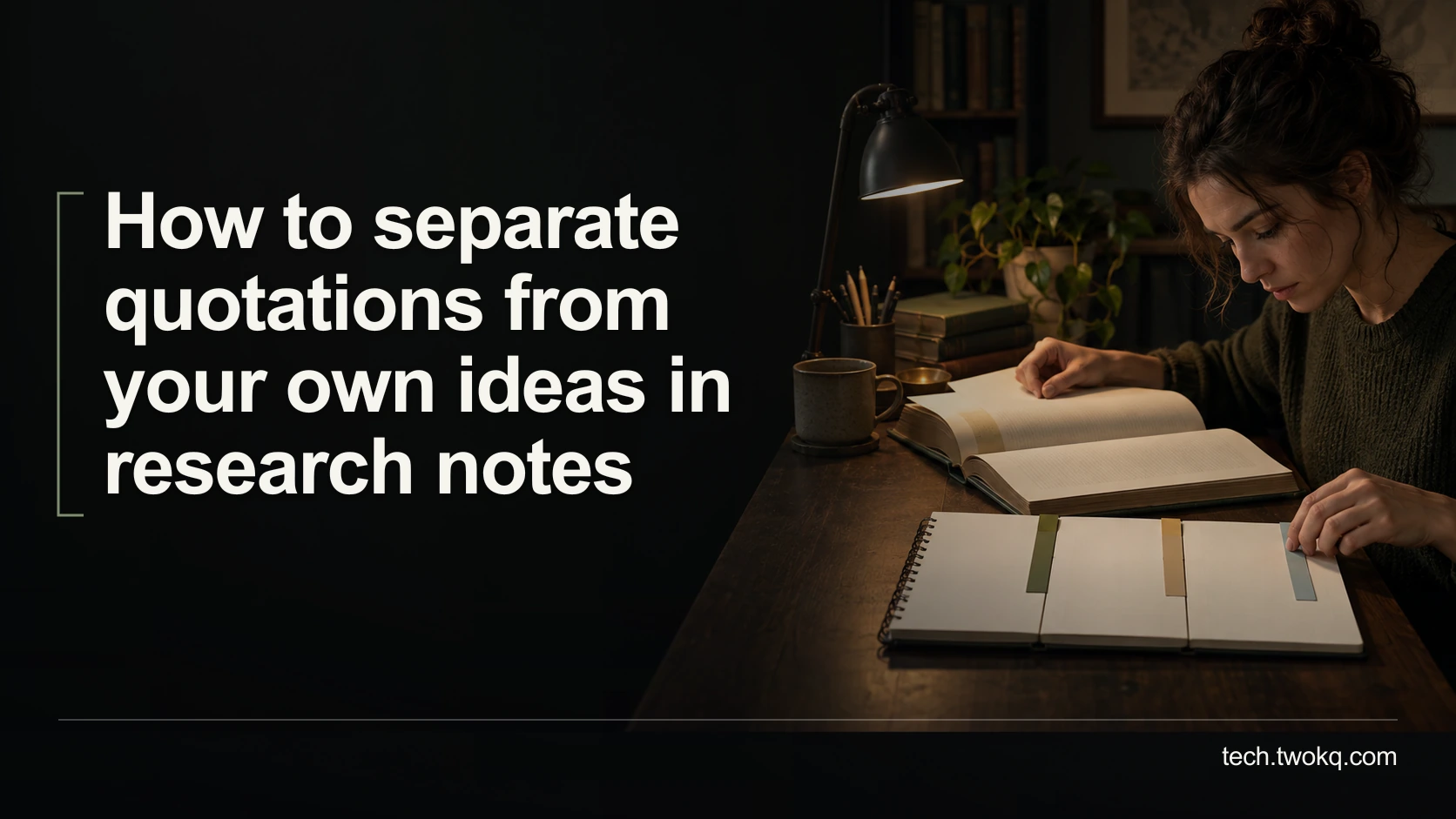
Build research notes that distinguish exact quotations, paraphrases and your interpretation, preserve source locations, and repair ambiguous older notes.
Direct answer: Label every extract as exact wording, paraphrase or your interpretation at the moment you capture it, and keep the source location beside that label. Put copied wording in quotation marks or a clearly marked quotation block; a source link alone does not show which words were copied. If an older note is ambiguous, mark it as unverified and return to the original before reusing it.
The problem usually appears later. A passage that was obviously copied when you first read it can look like your own fluent summary several weeks afterwards, particularly when it sits beside personal comments in the same font.
Your notes need to preserve two different things: what the source said and what you thought about it. The broader argument for keeping your own thinking in research notes depends on this distinction surviving the move from reading to writing.
Applies to: research notes in ordinary documents, note applications or reference managers. Academic citation styles and workplace rules vary; the method below does not replace them.
Create a source-voice record
A source-voice record is an editorial method for keeping authorship visible within a note. It is not a citation style. Each useful passage has a label describing its relationship to the source, followed by a location you can revisit.
Use “Exact wording” for a literal extract, “Paraphrase” for your restatement of someone else's claim, and “My interpretation” for the conclusion or question you add. Keep those labels as text. Colour can support them, but should not be the only distinction because it may disappear when copying or exporting.
The University of Oxford's guidance distinguishes properly identified quotations from unattributed copying and warns that changing a few words does not make another author's argument your own. That is an institutional academic standard, not a rule about which software to use. Oxford guidance on plagiarism
Before changing existing notes, save a copy or use a recovery mechanism you have checked. For confidential material, work inside the storage and applications your organisation permits. Repairing attribution does not justify uploading a private document to an external tool.
Capture a location precise enough to check
A link to the source homepage is rarely enough. Record the document title, author or organisation, version or date, and the page, section or timestamp supporting the particular passage.
Where page numbering differs, distinguish the printed page from the PDF viewer's page position. For a web page without page numbers, record its heading and a short identifying phrase. Add the date you accessed changing material, and preserve an authorised copy where your terms permit it.
The location should let another reader find the same passage without reading the whole document. Test it immediately. Close the source, reopen it from the note and locate the claim. If that fails, fix the reference before adding more extracts.
Do not confuse a citation manager's record with evidence that the quoted wording is accurate. Bibliographic details identify the source; the specific passage still needs checking.
Separate the three voices on a real task
Consider a fictional policy memo written solely for this example. It contains this sentence:
“Remote access is available to contractors after the project owner approves their request.”
Your note could preserve the sentence under “Exact wording”, with a fictional document title and section identifier clearly marked as example material.
Under “Paraphrase”, you might write: “Contractors can obtain remote access, but approval from the project owner is required first.”
Under “My interpretation”, you might add: “The handover checklist should identify the project owner so that access requests do not stall.”
The last statement is a proposed operational response. It is not something the source explicitly required. If you remove the label, a future reader may mistake your recommendation for part of the policy.
The distinction also catches a bad paraphrase: “Contractors have remote access.” That drops the approval condition. Rewriting the vocabulary has not preserved the meaning.
Draft a paraphrase without decorating the original
Read the relevant passage and the context around it. Then look away and explain the claim in words appropriate to your task. Reopen the source and compare the result for scope, conditions, strength and attribution.
Check the subject and the verb carefully. “Some participants reported” is not equivalent to “the study proved”. “May reduce” is not “will prevent”. Preserve uncertainty when it affects what the reader can conclude.
If a short technical phrase must remain unchanged because it is the correct term, retain it. The goal is not to disguise similarity by replacing accurate terminology with unusual synonyms.
Choose a direct quotation when the exact wording matters, such as a disputed promise or a carefully qualified definition. Otherwise, a concise paraphrase with a clear source can be easier to use. That is an editorial recommendation, not a rule that quotations are inherently inferior.
For assessed work, follow your institution's requirements concerning attribution, collaboration and AI assistance. Oxford's rules apply to Oxford; your course may impose different conditions. Ask your tutor about a specific uncertainty rather than assuming that an online article overrides local instructions.
Repair older notes without guessing
Create a temporary “source unresolved” label for passages whose origin or wording is uncertain. This is a quarantine state: they remain available for investigation, but not ready to appear as evidence in a draft.
Search the references already associated with that project first. If a distinctive phrase is public and not confidential, an exact-phrase search may help locate its origin. Finding the phrase on a secondary website does not establish where it first appeared.
Once you recover the source, compare the full passage, not just the matching words. Correct transcription errors, restore relevant qualifications and identify whether your note was a quotation, a paraphrase or a comment.
If the source cannot be found, you have several honest options: remove the claim, replace it with independently sourced evidence, or retain it as an unanswered question. Do not invent an author or page number to make the note look complete.
Prioritise the material you are about to publish or submit. An afternoon spent repairing irrelevant archived notes can delay checking the one paragraph that matters now.
Calculate the cost of deferred attribution
Imagine a freelance researcher preparing a briefing from 96 notes. All figures here are illustrative assumptions, not findings from a study.
Suppose 22 notes lack a clear distinction between quotation and commentary. Tracing each one takes an average of 6 minutes, and 10 need another 3 minutes to rewrite after the source check. Repair time is 22 × 6 + 10 × 3 = 162 minutes.
For comparison, assume adding a source location and voice label would have taken an extra 35 seconds for each of the original 96 notes. That is 96 × 35 = 3,360 seconds, or 56 minutes.
On those assumptions, earlier labelling would release 162 minus 56 = 106 minutes of later work. It would not eliminate source verification, and the calculation does not assign a financial value to the researcher's time.
The useful conclusion is narrower: the capture habit pays off if the later ambiguity it prevents is sufficiently expensive. Measure your own repair time before deciding how elaborate the record should be. A short source label may be enough for an informal reading log; a contested published claim needs more precise documentation.
Keep attribution separate from permission
Correct attribution tells readers where material came from. It does not automatically give you permission to republish it.
In the UK, quotation and other copyright exceptions depend on their conditions, including fair dealing where applicable. There is no universal safe word count in the government's guidance. Check the intended use, not merely whether you supplied a link. Intellectual Property Office guidance on copyright exceptions
Requirements vary by country, sector and contract. Seek qualified local advice when a substantial or commercially consequential reuse is uncertain. For the note-taking task itself, keep extracts proportionate to what you need to understand and verify.
Repair the next piece of writing today
- Set aside about fifteen minutes to add the three voice labels to a few notes from your current project. Keep a recoverable copy of the original material.
- Check one location from each note by reopening its source. Record any ambiguity rather than reconstructing it from memory.
- Spend the next half-hour auditing the passages supporting your current draft. Prioritise claims that change the argument or recommendation.
- Before sending the draft, either resolve each uncertain passage or remove its role as evidence. Schedule unrelated archive repairs separately.
Stop trying to rescue an attractive quotation when you cannot establish its wording and origin. Your argument should survive replacing it with something you can support.
Related guides
Frequently asked questions
Is a source link enough to identify a quotation?
No. A link identifies a destination, but it does not identify which words in your note came directly from it. Keep copied wording inside a clearly labelled quotation area and include a precise location. That makes the distinction survive when you move the passage into another document. If the source contains several authors, identify whose wording you are using. A link can also stop working or lead to a revised page, so record the title and date as useful context. How much additional detail you need depends on the eventual use.
Can I keep quotes and personal comments in the same note?
Yes, and keeping them together can preserve valuable context. The important condition is that their relationship remains explicit. Put the comment after the quotation under a separate text label, rather than inserting your view into the copied sentence. If you need to annotate within an extract, make the intervention visible and retain an unchanged reference copy. This avoids silently altering the source when you return to it later. Separate notes are useful for longer independent arguments, but creating extra files is not necessary merely to distinguish the author's words from yours.
What should I do with a quotation found in another article?
Find the original if you can, particularly when the exact wording affects your argument. Until then, record that you encountered it through the secondary article. Do not cite an original document as though you read it when you only saw somebody else's quotation. The secondary author may have shortened the passage or supplied a different translation. If the original remains inaccessible, follow the relevant citation style for indirect sources and limit the claim accordingly. A memorable sentence is not worth pretending that the evidence chain is stronger than it is.
Can AI identify which of my notes were copied?
Do not rely on it to decide authorship. An AI assistant may suggest likely matches or highlight inconsistent phrasing, but that is a lead to investigate, not proof of copying or originality. Compare the suspect passage with a source you can inspect and record the result yourself. Avoid uploading private notes without the required permission and applicable data checks. If your purpose is academic assessment, follow your institution's rules on AI assistance. A tool's confidence cannot repair a missing source or establish that an unattributed passage was independently written.
Should I correct grammar inside a direct quotation?
Preserve the original wording unless the quotation convention you are following allows a clearly indicated intervention. Quietly correcting a sentence can change both its meaning and its evidential value. If readability is the issue, paraphrase the point accurately and attribute it instead. When an apparent mistake could be a transcription problem, check the original document or recording before deciding what to reproduce. For publication, follow the relevant editorial style on omissions and bracketed clarification. The rule for your private note is simpler: keep an unchanged copy so later editing remains auditable.
Does everything I think need a source?
No. Your own interpretation, proposed action or unanswered question can be labelled as yours. However, if the interpretation relies on an external fact, preserve the evidence for that fact nearby. Separating the two makes it easier to challenge the reasoning without disputing the source's wording. You should also distinguish an observation you actually made from a hypothetical example. Academic disciplines and professional settings differ on what counts as common knowledge, so consult the relevant guidance when submitting formal work. The purpose is transparent reasoning, not attaching a reference to every ordinary sentence.
Sources and verification
- University of Oxford: Plagiarism. Checked distinctions concerning quotation, paraphrase, attribution and indirect sources; institutional rules are identified as such.
- UK Intellectual Property Office: Exceptions to copyright. Checked the qualified UK position on quotation, acknowledgement and fair dealing.
- Sources checked on 9 September 2026. The source-voice record, fictional policy sentence and repair-time figures are editorial examples.
- Parent content was read from the supplied project. Its specified public route could not be retrieved during verification; supplied internal paths are retained.
This article is practical guidance. Apply it in proportion to your tools, evidence, risks, and responsibilities.