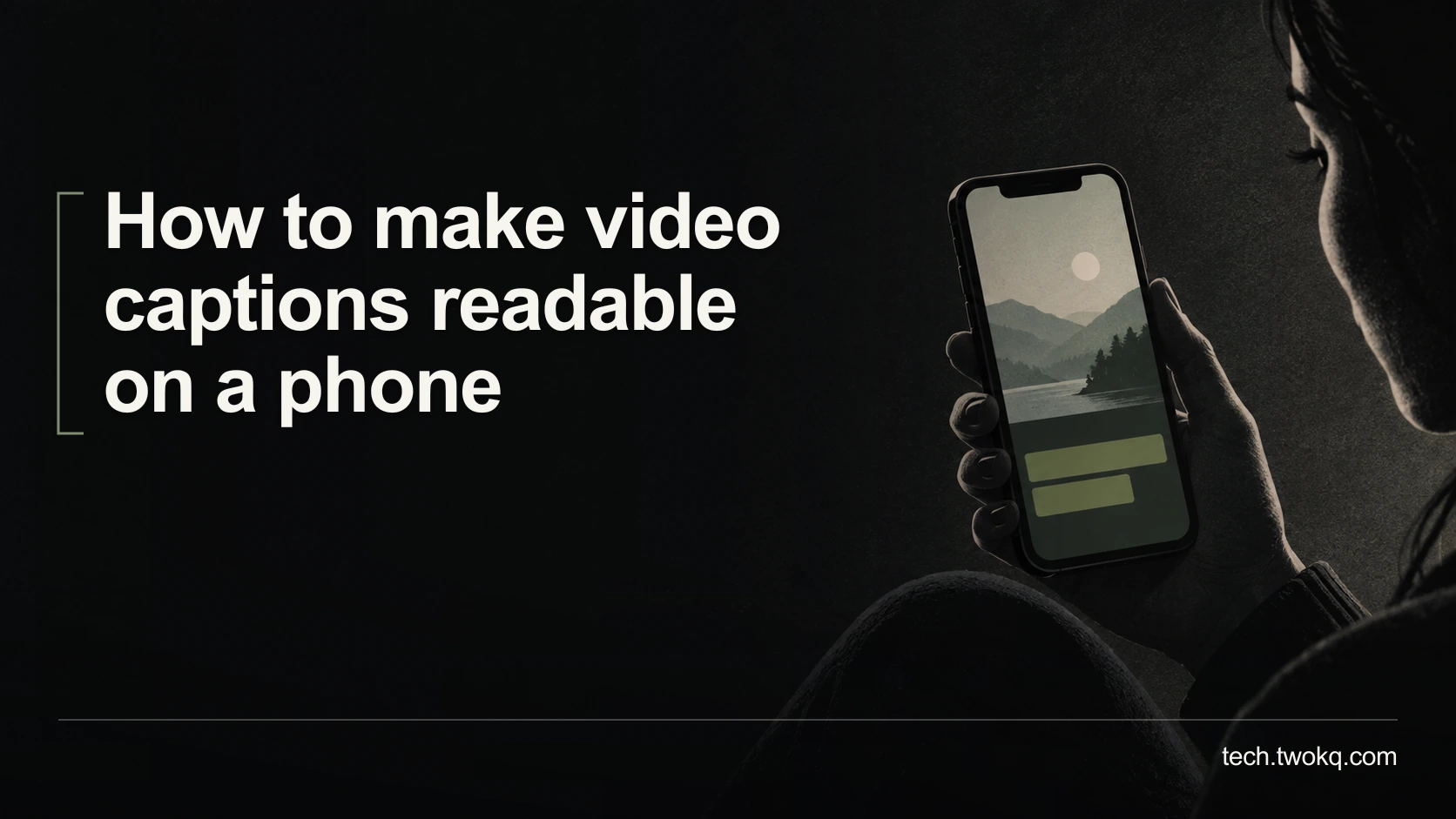
Check caption wording, timing, size and placement on a real phone, then fix the parts that make your video difficult to follow without relying on sound.
Direct answer: Correct the words first, then test caption timing, text size and placement on a phone in the player your audience will actually use. Watch with sound off and without pausing: if you cannot read the text while following the picture, fix that passage before exporting the whole video. Prefer a separate, switchable caption track where the destination supports it properly; use burned-in text when reliable visible delivery matters more than viewer customisation.
A caption can look attractive on an editing monitor and become unreadable inside a narrow mobile player. Making every word bigger is not a complete remedy. Text can still disappear too quickly, cover an instruction or compete with the player's controls.
The job is access to the information, not decoration. A plain presentation that preserves the speaker's meaning is usually a better default than animated words that make the audience work harder.
Applies to: prerecorded videos that you control and can revise, including tutorials, interviews and short social clips. Platform support varies. The method below is an editorial review process, not a claim of formal accessibility certification.
Run a caption viewing pass
The caption viewing pass is a practical method with four checks in order: meaning, reading time, available space and actual playback. Earlier failures invalidate later polish. There is little value in perfecting the colour of an inaccurate caption.
Before changing anything, save the original video project, source audio and caption file. Work on a duplicate sequence or version so you can reverse timing edits. Choose the actual destination and orientation before styling: a landscape video embedded in a page is not the same viewing space as a full-screen portrait clip.
Prepare a short test section containing fast speech, a long name, a speaker change and something important near the lower edge of the picture. These are selection criteria, not a requirement to invent content that is absent from your video.
This is the final-delivery problem within A Practical AI Video Workflow: From Brief to Final Cut. A production workflow can generate a caption draft; this pass decides whether viewers can use it.
Check meaning before appearance
Read each cue, meaning a timed block of caption text, while listening to the corresponding audio. Pay particular attention to names, quantities, negations and the order of instructions. A missed “not” can reverse the message even when the rest looks convincing.
W3C's caption guidance treats automatic captions as a starting point requiring accuracy checks, not a finished accessibility provision. Captions also need relevant non-speech information. If an off-screen alarm explains why somebody stops speaking, omitting it leaves viewers without part of the event.
Do not rewrite a hesitant speaker into a more definite position. If a passage is unclear, consult the source recording or the person responsible for it. Guessing a technical term and styling it confidently is still a transcription error.
Identify speakers when the picture and sequence do not make the identity clear. Keep labels concise and consistent. Put additional explanation in surrounding content rather than inserting your commentary into the speaker's words. W3C's transcription guidance distinguishes faithful transcription from adding or changing meaning.
Success means the text accurately carries the information an audience needs from the audio. If a viewer would act differently after reading the caption, resolve that discrepancy before moving on.
Give each thought enough reading time
Watch once without sound or pausing. Mark where you finish reading after the caption disappears, where a new cue interrupts a phrase, and where the text demands attention while the picture changes significantly.
Do not solve every crowded cue by shrinking the font. Try splitting at a natural phrase boundary, correcting a poorly chosen start or end time, or extending the edit with an appropriate pause if you control the presentation. Keep the text aligned with the speech; leaving an old sentence over a new speaker can create a different misunderstanding.
W3C recommends short caption lines and breaks at logical phrases in its transcription guidance. That is a useful starting point, not a reason to split a person's name or detach a negative from the verb it changes.
Work through one overloaded cue
Suppose a draft cue contains 68 characters, including spaces, and remains visible for two seconds. These are illustrative editing assumptions, not a measured audience test. Its presentation rate is 68 ÷ 2 = 34 characters per second.
If the actual spoken passage permits four seconds, the same text becomes 68 ÷ 4 = 17 characters per second. That halves the reading rate. It does not establish that 17 is a universal accessibility threshold: unfamiliar terminology, visual detail and the viewer's reading needs still matter.
If the speech only lasts two seconds and another sentence follows immediately, you cannot simply leave this cue on screen for four. Review the edit or split the text across genuinely available intervals. Two 34-character cues shown for one second each still require 34 characters per second. Splitting alone has not reduced the burden.
Recheck the repaired passage with sound off, followed by a sound-on synchronisation check. Keep whichever change improves comprehension without changing the message or creating a timing conflict.
Fit the text to the viewing space
Use a plain, readable typeface and a stable background treatment that separates letters from moving footage. Avoid choosing a colour solely because it matches the brand. A bright shirt or slide transition may remove the separation that looked adequate in the opening frame.
Start with a restrained one- or two-line layout, then test it. There is no useful universal pixel size without knowing how large the finished video appears on the phone. A number taken from a full-screen portrait preset may be unsuitable for a small landscape embed.
Check the longest cue, not just the neat opening sentence. Ensure that text does not cover a demonstrated button, an essential diagram label or a speaker's identifying information. Move the caption region or revise the visual composition where necessary. Do not force viewers to choose between reading the instruction and seeing the action.
My default is a consistent caption region with occasional deliberate exceptions, rather than text jumping around each shot. That makes the next line easier to locate. A video built around detailed lower-screen demonstrations may justify a different stable region from the outset.
Test the delivery method, not just the export
Separate captions are text and timing data supplied alongside a video. Burned-in captions are permanently drawn into its picture. Choose based on the destination, then check the actual result.
| Delivery | Viewer control | Revision burden | Main check |
|---|---|---|---|
| Separate caption track | Can support switching and display preferences, depending on the player | Text may be replaceable without rendering the picture again | Confirm the correct track loads and can be enabled |
| Burned-in captions | Fixed appearance and position | A wording correction requires a new video render | Confirm mobile scaling and overlays leave text readable |
| Both together | Depends on which track the viewer enables | Two versions must stay consistent | Check that duplicate text does not obscure the picture |
Do not assume every player honours your chosen caption styling. W3C notes that positioning and styling support varies. It also identifies caption display preferences and accessible controls as relevant player capabilities in its media-player guidance.
Use a private preview where available and permitted. View the destination on a phone, both with controls visible and after they disappear. Check the orientation your audience will use and one smaller embedded presentation if relevant. If uploading a confidential interview for testing, first use an approved service and confirm who can access that preview; an obscure link is not a substitute for appropriate access controls.
Complete a focused revision today
- Allow about ten minutes to correct and mark difficult passages in a short test section. Longer or technical footage will need proportionately more review.
- Spend another ten minutes testing that section on a phone. Record each failure as wording, timing, placement or player behaviour, then change the matching cause.
- Export or replace the revised captions and repeat the same viewing pass. Once the difficult section works, inspect the complete finished video, including the final sentence and any revised cuts.
Keep the last usable version until the replacement is checked. If your destination prevents readable captions or essential viewer controls, stop adjusting decorative details and change the delivery arrangement. For formal accessibility requirements or complex audience needs, arrange an appropriate specialist review rather than declaring success from your own phone alone.
Related guides
Frequently asked questions
Should every word appear separately in animated captions?
Usually not for explanatory content. Word-by-word animation can force the audience to follow your timing rather than read a phrase at their own pace. It can also make it harder to look away briefly and recover the sentence. Start with stable, meaningful phrases and introduce motion only when it has a clear communicative purpose. A short creative clip may deliberately use animated typography, but that does not make it a suitable substitute for an accurate caption track. Test the intended audience's task: remembering an instruction is different from appreciating a visual treatment of a slogan.
Can a transcript replace captions on a tutorial video?
A transcript is useful supplementary access, but it does not provide the same synchronised experience as captions. Someone following a demonstrated sequence should not have to search a separate document to discover what is being said at each moment. Provide accurate captions alongside a transcript when that combination suits the material and destination. The transcript can include navigable headings and useful links outside the spoken wording. If you need to meet a specific accessibility standard or contract, check its actual requirements rather than assuming one format substitutes for another. This article's phone check is not a compliance assessment.
Do captions need punctuation?
Yes, use punctuation that helps viewers understand the sentence and its intended structure. A question mark, comma or full stop can clarify meaning without extra words. Avoid treating every line break as a sentence ending, because the caption layout may divide one sentence across several cues. Preserve the distinction between what the speaker said and your interpretation of it. For rapid, informal speech, keep the punctuation readable rather than trying to represent every breath. If the recording supports two materially different readings, resolve the ambiguity with the source instead of letting a punctuation choice silently decide it.
What if captions overlap the platform's own subtitles?
Check whether the video contains burned-in text as well as an enabled caption track. Those are separate layers, and switching off one track will not remove words permanently rendered into the picture. For a video you control, keep an uncaptioned master so you can prepare the appropriate version for each destination. Preview with the platform's caption settings in their ordinary state and again with captions explicitly enabled. If both layers are required for a particular distribution workflow, plan their positions carefully. Do not solve the conflict by deleting the only accessible text option from every version.
How should I caption speech in two languages?
Decide whether you are transcribing each language or translating speech into one target language, then label the output accurately. A same-language caption and a translated subtitle serve different readers and require different review expertise. Keep speaker changes and important sound information clear whichever approach you use. Do not assume that an automatic translation preserves a qualification, joke or technical term because its grammar looks fluent. Have a suitably competent person verify consequential wording. If the destination supports separate language tracks, test their labels and selection controls; do not assume availability without checking that specific platform and account.
Is one phone enough to approve the final captions?
One phone is a useful first check, not evidence that every viewer can read the result. Start with the device and presentation most relevant to your audience, then inspect another screen size or orientation when your distribution makes that likely. Ask a reader unfamiliar with the script to watch a difficult section, because knowing the words can hide excessive reading demands. Include accessibility needs in the review rather than treating your own eyesight and reading speed as universal. For a low-risk personal clip this can remain proportionate; for education, essential instructions or contractual requirements, use a more formal review process.
Sources and verification
- W3C WAI: captions and subtitles. Checked on 9 September 2026 for caption purpose, automated-caption limitations and variable styling support.
- W3C WAI: transcribing audio to text. Checked on 9 September 2026 for faithful wording, relevant audio information and phrase-based line breaks.
- W3C WAI: media-player accessibility. Checked on 9 September 2026 for display preferences and accessible playback controls. No specific platform interface or compliance certification is claimed.
- The supplied parent guide was read in the publication's local source. Its public route could not be retrieved during verification; its supplied URL is retained without claiming a successful live-page check.
This article is practical guidance. Apply it in proportion to your tools, evidence, risks, and responsibilities.