Prepare a minimal, synthetic document outline for AI feedback, check direct and indirect identifiers, and inspect hidden information without claiming anonymity.
Direct answer: First check that the proposed AI use is permitted, then create a new outline containing only the headings, argument order and invented examples needed for structural feedback. Replace both direct identifiers and revealing contextual details, and inspect any file you intend to upload for hidden information. Do not describe the result as anonymous merely because names are removed; if you cannot reduce the disclosure sufficiently, use an approved human review or keep the work local.
Structural feedback rarely requires a complete proposal, customer history or personnel narrative. Sending the full document and asking the model to ignore private details defeats the purpose: the information has already been submitted.
My default is to create a fresh, minimal representation rather than redact the original file. Redaction can be appropriate in an established, reviewed process, but for a simple question about section order it is usually more complicated than the task requires.
Applies to: permitted editorial feedback on document organisation. UK data-protection distinctions are noted; requirements vary by jurisdiction, sector and contract. This workflow does not certify anonymisation.
Use the disclosure-minimising preparation pass
The disclosure-minimising preparation pass is an editorial method for preserving the structure you need reviewed while removing material unnecessary to that review. Its first question is not “Which names can I hide?” but “What does the reviewer actually need to see?”
Write the feedback question before preparing any input. For example: “Does the proposal explain the problem before presenting the budget?” That may require only section headings and one generic sentence about each section.
Distinguish structure from substance. If you want the model to judge whether a particular employee's behaviour supports a conclusion, you are no longer asking only about organisation. That task needs a separate assessment of appropriateness, information handling and qualified judgement.
The focused knowledge-work workflow recommends bounded transformations. Here the boundary is the smallest representation that lets you ask the organisational question without exposing the underlying personal story.
Check permission before changing the document
Confirm who owns the document and whether your organisation or client permits the selected service and account. Removing identifiers does not automatically override confidentiality, contractual restrictions or workplace rules. Commercially sensitive content can remain sensitive even when it contains no personal names.
The UK ICO distinguishes anonymisation from pseudonymisation, where identifying information is replaced but a person can still be linked through additional information. Its guidance says pseudonymous information remains personal data and warns that removing obvious identifiers may leave people identifiable from context. The page is currently marked as under review following legislative changes. ICO introduction to anonymisation.
Treat that distinction as a reason to avoid casual claims of anonymity. For a specific legal assessment, consult the responsible data-protection professional or qualified local adviser. This article offers a minimisation workflow, not a determination that any particular document can lawfully be uploaded.
Keep an untouched original in its approved location. Create the review outline separately so that removing details does not damage the source or erase evidence someone needs for the real work.
Replace direct identifiers and revealing context
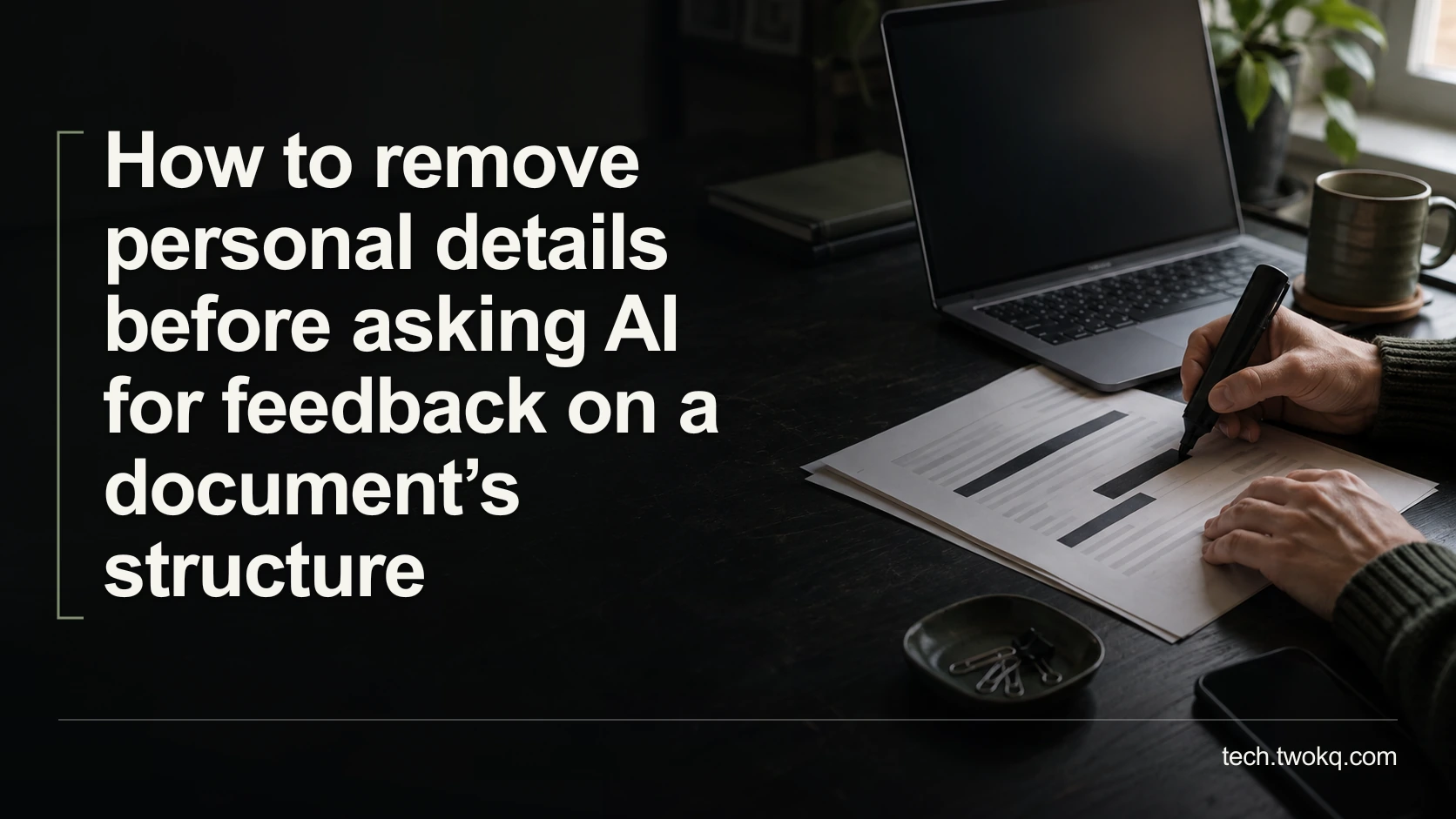
Start with names, addresses, email addresses, phone numbers, customer references and links to private accounts. In a fresh outline, use role labels such as “Project sponsor” or “Participant A” only where a relationship matters to the structure.
Then inspect the contextual clues: a unique job title, an exact incident date, a very small location, a distinctive project or a quotation easily connected to a person. A generic name does little if the surrounding description identifies the only person who could fit it.
For structure feedback, replace the entire detail with a functional description. “A paragraph gives a case example” may be enough. If the sequence depends on a delay, say “after the review period” rather than retaining an exact date unless that precision is genuinely necessary.
Do not keep a replacement key in the uploaded material. If you need one for your own work, store it separately under the relevant controls. Avoid using real-looking invented email addresses or phone numbers that could belong to somebody; use clearly labelled placeholders instead.
Inspect quotations and attachments as well as prose. A screenshot can contain account names, document titles or another person's comments. If an image is unnecessary to the structure question, omit it entirely rather than trying to hide each visible clue.
Prefer a new outline to a cosmetically altered file
Build a clean text outline with heading levels, short section summaries and the intended reader action. Preserve the order and relationships that matter, but leave out evidential detail that is irrelevant to the review.
For example, the outline might contain “Problem statement”, “Evidence summary”, “Options”, “Recommended action” and “Cost assumptions”, with a sentence explaining each role. These labels are not a universal recommended order; they give the reviewer enough structure to identify whether your actual sequence fits the question.
Do not merely change text colour, cover text with a shape or crop a screenshot and assume the hidden material is gone. If you must share a file, use the application's documented inspection and removal process and verify the resulting copy. A visual appearance is not a complete account of file contents.
For Word on supported Windows desktop versions, Microsoft recommends inspecting a copy because removed information may not be recoverable. Its documented route is File > Info > Check for Issues > Inspect Document; review findings before removing selected content and inspect again afterwards. The tool has limitations, so it complements rather than replaces content review. Microsoft Document Inspector guidance.
If your platform lacks the same controls, do not invent an equivalent menu. Consult its documentation or use the fresh minimal text outline instead. Reopen the exact file you plan to submit and review that copy, not merely the source you believe it came from.
Account for replacements without inventing a privacy score
Consider a fictional draft proposal containing 23 direct identifier occurrences and six contextual clues. Your first pass replaces all 23 direct occurrences. A second review finds that four contextual clues can be generalised and two are unnecessary, so you remove them.
The review record now accounts for 23 + 4 + 2 = 29 identified items. That does not mean the document is “100% anonymous”. It means you addressed the 29 items you identified; an unrecognised clue or hidden file detail could still remain.
Suppose the first outline also contains eight section headings and a one-sentence summary of each. If each summary averages an illustrative 18 words, that is 8 × 18 = 144 words of section description, plus the headings. The original 2,400-word document need not be submitted for the simple ordering question.
These counts are invented assumptions, not an inspection performed on a real document. The useful comparison is the amount of unnecessary material avoided. It is not a probability of re-identification or a claim that a particular word count is safe.
Ask someone authorised to review the prepared outline if the material remains sensitive. Their task is to look for what the outline still reveals, not merely confirm that the original names are absent.
Request feedback that stays inside the boundary
Tell the assistant what the outline represents and what you want assessed. Ask about sequence, missing transitions or whether the requested decision arrives before necessary context. Do not invite guesses about the missing personal facts.
When feedback arrives, apply it locally to the real document yourself. The model does not need the original to see whether “budget before objectives” might confuse the intended reader. If it asks for more detail, assess whether that detail is necessary and permitted before supplying anything further.
Keep the response as advice about structure, not evidence that the underlying argument is true. A well-organised document can still contain unsupported claims, and the deliberately limited input cannot establish their accuracy.
Prepare one safe review request in twenty minutes
- Spend five minutes confirming permission and writing the exact structural question.
- Use ten minutes to create a new minimal outline, replace direct details and remove revealing context that the task does not need.
- Spend five minutes inspecting the final input and any file metadata, then ask only the bounded question if the disclosure is acceptable.
- Apply useful feedback to the original locally and retain the untouched source for recovery.
Stop if permission is missing, if the needed context remains sensitive or if you cannot inspect the file confidently. In that case use an authorised reviewer rather than assuming another round of name replacement solves the problem.
Related guides
Frequently asked questions
Is replacing names with initials enough?
Not reliably. Initials can still be identifying, especially when combined with a role, location, date or distinctive event. For a structure-only question, use generic role labels or remove the personal example entirely if it is unnecessary. Check what the remaining description reveals rather than focusing solely on the name field. Do not claim that the result is anonymous without an appropriate assessment. If the relevant context remains personal or confidential, the selected service still needs to be approved for that material, or the review should happen through another suitable process.
Can I ask AI to remove the personal information for me?
Not by uploading sensitive material to the very service whose exposure you are trying to avoid. That sends the information before the removal occurs. An approved internal process may use automated detection as one stage, but its permissions and data handling need to be established separately. For a small structural review, create the minimal outline yourself and check it before submission. Automated detection can also miss contextual clues, so do not treat a clean result as proof of anonymity. The question is what leaves your approved environment, not merely what appears in the generated output.
Does plain text contain no private information?
No. Plain text can still contain names, unique facts, identifiers, copied links and revealing wording. It may simplify the file-format problem, but it does not solve the content problem. Inspect the exact text you plan to submit and remove details unnecessary to the task. A fresh generic outline is useful because it limits what you include deliberately, not because its format guarantees privacy. Also consider what your account or conversation context may reveal independently of the text. If you cannot explain the complete relevant disclosure, keep the review within an approved alternative workflow.
Should I change all dates and numbers?
Change or remove them when their precision is unnecessary or revealing, but preserve the relationships needed for the structural question. If the argument depends on a sequence, generic stages may suffice. If it depends on scale, an explicitly invented proportionate example may help without reproducing the real figures. Do not create inconsistent replacements that cause the reviewer to criticise a problem the original does not have. Keep any mapping separate and do not upload it. When exact figures are essential, reassess the task and permissions rather than pretending the request is still only about structure.
What if the document includes commercially confidential information but no people?
Treat confidentiality as a separate issue. Removing personal identifiers does not authorise sharing an unpublished strategy, client proposal, pricing arrangement or proprietary process. Check the relevant contract and organisational policy before using the service. A structural outline can often omit the sensitive substance, but make sure its headings and summaries do not reveal the same information indirectly. If the review genuinely requires confidential detail, use an approved environment or authorised human reviewer. Data-protection terminology should not distract from other obligations that apply to the document and the people responsible for it.
Can I restore the original details after receiving feedback?
Yes, in your own approved working copy, if you retained the original and know which structural changes you intend to apply. Do not upload the mapping or original merely to ask the assistant to restore it. Review the resulting document for meaning because a reordering that works with generic placeholders may need different transitions in the real text. Keep the original available so rejected changes are reversible. The feedback is a suggestion about organisation, not an instruction to restructure every section or a certification that the final document is accurate and ready to share.
Sources and verification
- ICO: introduction to anonymisation, checked 11 September 2026 for the distinction from pseudonymisation and its current review notice. This article does not determine the legal status of a reader's data.
- Microsoft: inspect documents for hidden information, checked for supported inspection controls and the instruction to work on a copy.
- The parent was read locally after its public URL could not be retrieved. Supplied paths are retained without independent live confirmation. The proposal example and method are illustrative editorial work.
This article is practical guidance. Apply it in proportion to your tools, evidence, risks, and responsibilities.