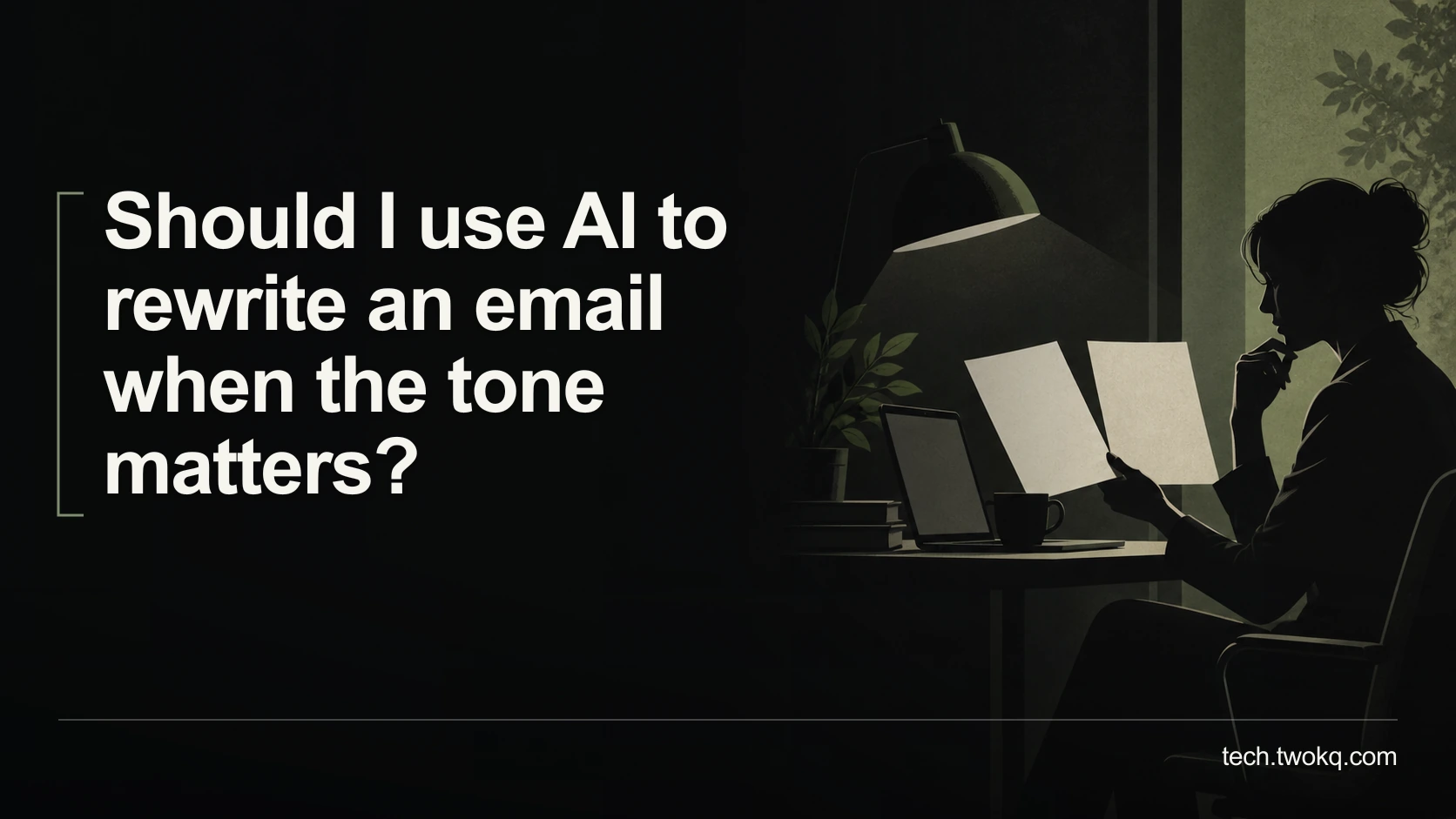
Use AI to revise an email's tone without changing promises, deadlines or boundaries, then check the final wording against what you genuinely intend to say.
Direct answer: Yes, for a bounded wording task, if you decide the message's facts, commitments and boundaries first and review the rewrite before sending. Ask for clearer or calmer language, not a new position, and compare every promise, deadline and statement of certainty with your original intention. For a consequential dispute or a deeply personal message, write the substance yourself and use appropriate human advice rather than outsourcing the judgement to AI.
Tone is not separate from meaning. Replacing “I can investigate” with “I will resolve this” sounds reassuring but makes a different commitment. Removing a condition can make an email warmer while leaving you responsible for something you never agreed to do.
I recommend using AI as a sentence-level editor after you know your position, not as the person who decides what you should concede. Another approach can be better when you are merely exploring possible responses privately, but those possibilities must not become promises by accident.
Applies to: ordinary correspondence in an approved writing workflow. This is an editorial review method, not legal advice or a claim that a particular AI product preserves meaning reliably.
Use the commitment-preserving rewrite
The commitment-preserving rewrite is an editorial method: identify what must not change, revise the wording, then compare the resulting commitments. Its purpose is not to make every email sound the same. It is to ensure that a more polished version still belongs to you.
Before prompting, write the facts you know, the action you can take, the action you cannot promise and the response you need. Mark dates and conditions explicitly. If you are uncertain whether you can meet a deadline, that uncertainty is part of the message rather than an awkward phrase to remove.
For example, a freelance designer might intend to say that a revision is possible after receiving approved images, but that extra animation needs a separate estimate. Those boundaries matter more than whether the greeting is warm enough.
The focused AI workflow guide keeps objective and judgement with the person. Here you retain control through a short record of what the email must continue to mean after editing.
Supply only the context the editor needs
Do not paste an entire confidential email chain into a service simply to make one sentence less abrupt. Identify the relevant relationship and task in generic terms, then use synthetic names or a short approved extract where possible.
Check whether your organisation permits the particular service and account for the material. Customer details, health information, internal disagreements and contractual negotiations may need a different process. A privacy setting alone is not a substitute for permission to share somebody else's information.
Keep the original draft in your own document or email draft. Work with a separate copy so that rejected suggestions do not overwrite your starting point. Do not enable automatic sending or inbox access for a rewriting exercise that only needs text.
If the message concerns employment action, a legal dispute or another consequential obligation, involve the relevant qualified adviser for your jurisdiction. This article's wording examples do not determine what you should admit, promise or withhold in those situations.
Give a precise editing instruction
Ask for the specific change you want: less accusatory wording, a clearer request or a shorter explanation. “Make it professional” is ambiguous and can encourage ceremonial language that obscures the actual task.
A useful instruction is: “Make this email calm and clear. Preserve every fact, date, condition and limit. Do not add apologies, promises or reasons. Flag any sentence you cannot revise without changing its meaning.” This is a proposed prompt, not a guarantee of compliance.
Give an audience constraint only when it matters. A long-standing colleague and a new customer may need different context, but neither requires invented familiarity. Ask for an alternative sentence rather than a complete rewrite when only one passage is troublesome.
GOV.UK's clear-language guidance recommends familiar wording, explained technical terms and direct statements of action. Those principles are relevant here, although its government publishing rules are not a universal email style. Clear language is a better target than unnecessary formality. GOV.UK clear-language guidance.
Inspect promises before politeness
Read the proposed rewrite once for commitments without judging its elegance. Underline what you will do, by when, at whose cost and under which conditions. Compare those statements with your intention record.
Look particularly at modal verbs: can, may, will, would and must. Their differences are not decorative. “I may be able to send a draft” leaves capacity unresolved; “I will send a draft” does not.
Check whether an apology admits something you have not established, whether gratitude implies agreement and whether a softening phrase conceals a necessary refusal. Do not remove empathy, but choose it consciously. “I understand this delay is inconvenient” and “This was entirely my fault” are different statements.
Now inspect dates and dependencies. Replace “soon” with a real timeframe only if you can commit to it. Preserve “after approval” when approval is genuinely required. If the assistant has removed the condition, restore it even if the sentence becomes slightly longer.
Finally read for the recipient's next action. They should understand what is decided, what remains open and what you need from them. Politeness that prevents the recipient from recognising a refusal is not successful communication.
Work through five revised sentences
Consider a fictional designer reviewing five AI-rewritten sentences. Two alter commitments: one changes “estimate the work” into “complete the work”, and another removes the condition that images must first be approved. A third replaces a specific decision date with an ambiguous “shortly”. The other two preserve meaning.
The review identifies 2 + 1 = 3 sentences needing correction, leaving 5 minus 3 = 2 acceptable sentences. These counts describe an invented example, not a measured error rate for any tool. The consequence matters more than the percentage: either changed commitment could create an expectation the designer cannot meet.
Assume writing the initial brief takes two minutes, generation takes one minute, reviewing all five sentences takes three minutes and correcting the three problems takes one minute each. Total effort is 2 + 1 + 3 + 3 = 9 minutes.
If editing the original manually would take an illustrative six minutes, the AI route adds 9 minus 6 = 3 minutes. That does not mean AI rewriting is always slower. It means this short email did not benefit enough to justify the process. A longer difficult draft might produce a different result, but you must measure that separately.
Use the exercise to identify what helped. Perhaps one clearer opening sentence was useful while the full rewrite was not. You can keep that sentence and reject the rest. Adoption is not an all-or-nothing decision.
Read the final message as a recipient
After correcting meaning, read the email aloud or use your usual accessible reading method. Does it sound like something you would actually say? Can the recipient distinguish a firm boundary from a tentative possibility?
Check names, attachments, recipients and quoted history in the actual email application before sending. A carefully edited body does not protect against sending it to the wrong person or attaching the wrong file. Keep those checks outside the model's judgement.
If the message remains emotionally difficult, pause rather than repeatedly asking for a more persuasive version. A short conversation, followed by an agreed written record, may resolve ambiguity better than polishing an increasingly elaborate email.
Make one controlled revision today
- Spend three minutes writing the intended outcome and the facts, conditions and commitments that must remain unchanged.
- If the service is approved for the material, request one bounded rewrite using only necessary context.
- Spend five minutes checking commitments, dates and the recipient's next action before considering style.
- Keep only changes you can explain and endorse. Review the actual recipients and attachments, then send manually when the message is ready.
Stop using the rewrite if repeated edits keep changing your position or if you cannot decide what you genuinely want to say. Resolve that decision yourself or with an appropriate person before returning to wording.
Related guides
Frequently asked questions
Is it dishonest to use AI to improve an ordinary email?
Not inherently, but you remain responsible for the message and should follow relevant workplace or professional disclosure rules. Editing assistance is different from claiming personal experiences, feelings or commitments you do not hold. Read the final text carefully and remove invented reasons or familiarity. If the context expects an unaided statement or a personal reflection, consider whether assistance would misrepresent what the recipient is receiving. The useful test is whether you can stand behind every sentence and explain the process honestly if asked, not whether the wording looks sufficiently natural to avoid detection.
Can AI help me sound less angry without weakening a boundary?
Yes, as an editing aid, if you state the boundary explicitly and check that it survives. Remove accusations you cannot support and describe the observable issue, its consequence and the response you need. Do not let a calmer tone turn a refusal into an invitation to negotiate unless that is your intention. Ask for a revision of the specific heated passage rather than a new overall position. If you are too upset to judge the result, pause before sending. A polished email written in anger can still create a commitment or conflict you later regret.
Should I ask for several versions and choose the nicest one?
Only if each version is checked for meaning before you choose by tone. The nicest-sounding option may add an apology, promise or concession that changes the message. For a short email, two alternatives for one sentence can be more useful than several complete drafts. Compare the actual commitments and the recipient's likely interpretation, then choose wording you would comfortably defend. If none preserves your intention, edit the original yourself. More options do not automatically improve the decision, especially when they make it harder to notice small but consequential changes.
What if the rewrite makes my English clearer than I could write unaided?
That can be a legitimate benefit, provided the final message expresses what you intend and meets any applicable rules. You do not need to preserve avoidable language difficulty to make communication authentic. Check unfamiliar words and any phrase that seems to alter certainty, responsibility or timing. Ask for a plain explanation if you cannot confidently interpret a proposed sentence. Do not send wording you would be unable to clarify in a follow-up conversation. Clearer English should help the recipient understand your position, not replace it with a position selected by the tool.
Can I use AI to decide whether I should apologise?
You can use it to explore possible interpretations, but the decision requires your understanding of what happened, your responsibility and the relationship. Do not treat a generated recommendation as evidence that you caused a problem or owe a particular remedy. Separate empathy for someone's difficulty from factual admissions and commitments. For legal, employment or other consequential disputes, obtain appropriate advice before sending a message that may affect your position. Once you decide what you genuinely want to acknowledge, AI can help phrase it clearly without inventing facts or expanding the apology beyond your intention.
How do I know when to stop editing?
Stop when the message states the relevant facts, preserves your actual commitments and makes the next action understandable. Further polish is not useful if it only replaces ordinary language with formal phrases. Set a short review window for routine correspondence and use the original if the rewrite introduces more work than it removes. For a consequential message, take the time needed for appropriate human review rather than treating speed as the main goal. If you keep changing the substance, the unresolved problem is probably the decision itself, not the quality of the sentence.
Sources and verification
- GOV.UK: use clear language, checked 11 September 2026 for plain-language and direct-action guidance. Its principles inform a limited editorial recommendation, not a claim about AI performance.
- The parent was read in local publication files after public retrieval failed. Supplied internal paths are retained without independently confirming live publication. The commitment review and numerical scenario are original editorial examples, not tested product findings.
This article is practical guidance. Apply it in proportion to your tools, evidence, risks, and responsibilities.