Diagnose broken AI citations by checking source identity, locating moved pages and verifying the actual claim before treating a reference as usable evidence.
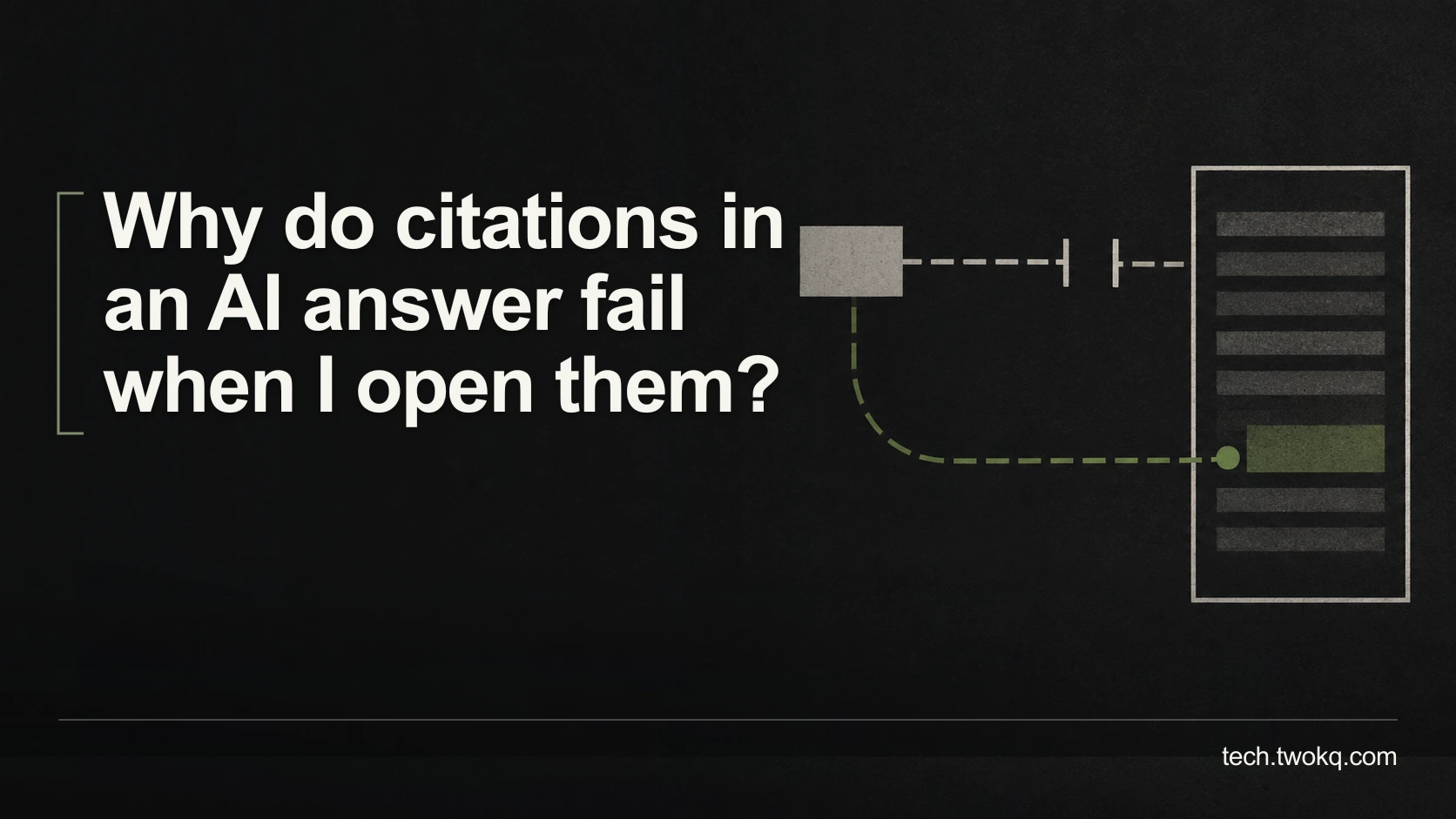
Direct answer: A failed citation may contain an invented source, a wrong identifier, an outdated address or a real page that you cannot currently access. Check the source's title, author or publisher and date independently, then locate the actual document and inspect the passage supporting the claim. Until you can do that, mark the claim unverified rather than treating a plausible reference or a repaired link as evidence.
A clickable citation has two jobs: identify a source and support a statement. It can fail at either. A link that opens successfully may point to the wrong paper, while a broken link may refer to a genuine document that has moved.
I recommend a short recovery attempt followed by replacing or removing unsupported claims, not repeatedly asking the assistant for new links until one opens. The exception is an essential specialist source, where a librarian or subject expert may justify a more substantial search.
Applies to: AI-assisted research and writing. This is a source-verification workflow, not a measured comparison of citation accuracy across products.
Use the citation identity check
The citation identity check is an editorial method with two gates: establish which source exists, then establish what it supports. Passing the first does not pass the second.
Copy the claim and proposed reference into a small verification note. Preserve the supplied title, author, date, publication and identifier exactly so you can see which details change during recovery. Do not silently replace them with a near match.
For an academic paper, an identifier may be a DOI, a digital object identifier used to identify a particular work. For product documentation, the important identifiers may instead be the product, feature, account tier and version. A broadly related page is not necessarily the source the claim requires.
The focused knowledge-work guide keeps evidence attached to important claims. This narrower method tells you what to do when the proposed evidence falls apart at the first click.
Separate access failure from identity failure
Start by reading the browser's actual result. A sign-in screen, a missing-page response and a different article are distinct outcomes. Record what you observe without guessing the underlying cause.
If the source requires a legitimate subscription or institutional account, use your normal authorised access. Do not bypass access controls or enter credentials into an unfamiliar page just because a citation sent you there. Verify the publisher's domain independently before signing in.
If a page is missing, search the publisher's site for the exact title and a distinctive phrase. A new address may establish that the same document moved. Compare title, author, date and content before replacing the URL.
If the page opens but its identity differs, do not treat it as a repaired citation. A DOI belonging to another paper is evidence of a mismatch, not evidence that the proposed study exists somewhere else.
Anthropic's support documentation acknowledges that Claude can produce links that do not work and describes limitations in generated claims about external actions. This is a vendor warning about a possible failure, not evidence of how often it occurs in any particular workflow. Anthropic's explanation of non-working links.
Recover the source through an independent route
For research papers, search the title together with an author or journal rather than searching only the generated URL. Crossref's metadata search supports looking up scholarly records using details such as titles, authors and DOIs. Its record can help establish source identity, but it is not a substitute for reading the work. Crossref search help.
Compare any candidate's bibliographic details carefully. Similar titles may describe different studies, a preprint may differ from the final publication, and a correction may affect the statement you intended to cite. Do not combine the title from one record with the author list or date from another.
For official guidance, use the organisation's own navigation or search to locate the specific document. Check whether it is current, archived, withdrawn or superseded. A historical page can still be useful if you are describing that period, but not automatically for present instructions.
Crossref explains that its retrieval services provide deposited metadata and reference matching. That describes a discovery mechanism, not an independent endorsement of the research or the claim an AI attached to it. Crossref metadata retrieval documentation.
If you cannot find an exact identity, record “not verified” rather than declaring with certainty that the work never existed. You can reject a reference for your draft without making a universal claim about every archive or database.
Verify the statement after fixing the address
Open the actual source and locate the relevant section. Ask whether it supports the exact subject, direction, magnitude and conditions of the claim. A paper about one task does not establish the same result for every use of a technology.
Check whether the figure is a measured result, an estimate, a vendor claim or somebody else's cited statement. If the source itself cites another document for the important number, follow that chain to the original evidence where available.
Do not rely only on a search snippet or abstract for a detailed methodological claim. If the necessary full text is unavailable, narrow what you say to what you can verify or choose another source. State that limitation rather than filling gaps from the assistant's explanation.
Watch for a common near miss: the source discusses the same topic but contradicts the generated conclusion or supports only a weaker version. Correct the sentence to match the evidence, or remove it. The goal is not to rescue the original wording at any cost.
Work through ten suggested references
Imagine a student checking ten AI-suggested references for an essay. This is a fictional audit, not a product benchmark. Six links open to the correctly identified works. Four fail initially.
Of those four, two are located at new publisher addresses, one contains a DOI for a different paper and one cannot be independently identified. That gives 6 + 2 = 8 identified sources, with 2 references still unverified. The two recovered addresses are link failures, not necessarily fabricated works.
The student then reads the relevant passages in the eight identified sources. Suppose three do not support the claims attached to them. Only 8 minus 3 = 5 source-and-claim pairs are ready to use in this example.
Calling this an “80% accurate bibliography” would conceal the second failure. Calling it a universal “50% AI accuracy rate” would also be wrong: the ten items were one invented situation, not a representative test. The useful output is five usable pairs and five specific problems to resolve or remove.
Assume an editorial recovery limit of eight minutes for each initially broken reference. Four attempts require up to 4 × 8 = 32 minutes, before reading and evaluating the sources. That limit is a working rule to protect this student's time, not a research standard. An essential source may deserve help from a librarian; a decorative statistic usually does not.
Keep a compact evidence record
For each retained claim, store the verified source title, exact address, relevant location, access date and a brief note about what it supports. Separate your interpretation from the source's finding. This makes later editing possible without reopening the entire conversation.
If a reference changes, update both the link and the associated sentence. Do not leave a stronger claim attached to a replacement source that supports less. If evidence remains unavailable, say what is unknown or omit the statement.
Keep quotations short, accurate and within the rights and citation requirements of your work. Having access to a paper is not permission to reproduce it extensively. Use your institution's or publication's standards for the final reference format.
Repair the evidence before continuing the draft
- Spend five minutes listing the claims whose references fail or look mismatched. Prioritise those that change the article's recommendation.
- Give each ordinary reference a bounded independent recovery attempt using the publisher or an appropriate catalogue.
- Read the relevant passages of every recovered source and revise the claims to match their actual scope.
- Remove unresolved supporting claims before submitting, or ask a librarian or subject expert about an essential source with the evidence you have collected.
Stop when repeated searching produces only variations of the same unverified reference. Another fluent citation is not progress unless it leads to identifiable, relevant evidence.
Related guides
Frequently asked questions
Does a broken link prove that AI invented the source?
No. The address may have changed, access may require authentication or a detail may have been copied incorrectly. Investigate source identity before deciding what failed. Search the exact title with an author or publisher and compare any recovered document's details. If you cannot establish the source, mark it unverified and do not use it as evidence. That is a sufficient editorial decision without claiming certainty that it never existed. The important distinction is between a source you can rely on now and one whose identity or contents remain unresolved.
Is a real DOI proof that the claim is correct?
No. A valid identifier can lead to a real work that says something different from the sentence it accompanies. Confirm that the DOI matches the intended title and authors, then read the relevant part of the source. Check the population, task, timeframe and limitations before generalising its findings. Do not treat bibliographic accuracy as factual support. If the source supports only a narrower statement, rewrite the claim accordingly. A DOI is useful for identifying a work; it is not a certificate that every statement linked to it is true.
Can I cite an abstract if I cannot access the full paper?
You can describe what the accessible abstract actually states, provided that is sufficient for the claim and your publication's rules permit it. Do not pretend to have read methods, results or limitations that you could not access. If your recommendation depends on those details, obtain authorised access or use another source. A summary may omit qualifications essential to interpretation. Keep the limitation explicit in your notes and wording so a later editor does not turn an abstract-level observation into a stronger claim supposedly supported by a complete review of the paper.
Should I ask the assistant to give only verified references?
You can ask, but the instruction does not make verification happen by itself. Check whether the application actually used a retrieval tool and still inspect the resulting sources. A statement that references were verified is not evidence of the particular checks performed. Ask for enough bibliographic detail to investigate independently, then retain only source-and-claim pairs you can establish. If browsing was unavailable, treat suggested references as leads rather than finished citations. A cautious prompt can shape the draft, but it cannot replace your responsibility for the evidence used in the final work.
What should I do with an archived page?
Use it only when its date and status fit the claim you are making. An archived instruction may explain how a service behaved previously but fail to describe its current interface or policy. Compare it with current official documentation before offering present-day advice. If the historical version is the relevant evidence, label the timeframe clearly and preserve its exact address. Do not silently substitute it for a missing current page. When the current position cannot be verified, narrow the recommendation or state the uncertainty rather than presenting old guidance as still authoritative.
How can I avoid spending all day repairing a bibliography?
Prioritise claims that determine the argument and set a reasonable recovery limit for non-essential references. Search independently, record the outcome and replace unsupported claims with evidence you can actually inspect. Do not keep a statistic merely because it makes the draft sound authoritative. For an essential specialist source, bring its title, suspected identifier and your search record to a librarian or relevant expert. A shorter argument supported by clear evidence is usually more useful than a long bibliography of uncertain leads. Stop polishing prose that depends on a source you have not established.
Sources and verification
- Anthropic: non-working links and unsupported external-action claims, checked 11 September 2026 for the vendor's stated limitation, not a failure-rate estimate.
- Crossref metadata search help and metadata retrieval documentation, checked for discovery and identity-checking capabilities.
- The parent guide was read locally after its public URL could not be retrieved. Supplied internal paths are retained without asserting independent live-publication verification. The ten-reference example is invented.
This article is practical guidance. Apply it in proportion to your tools, evidence, risks, and responsibilities.