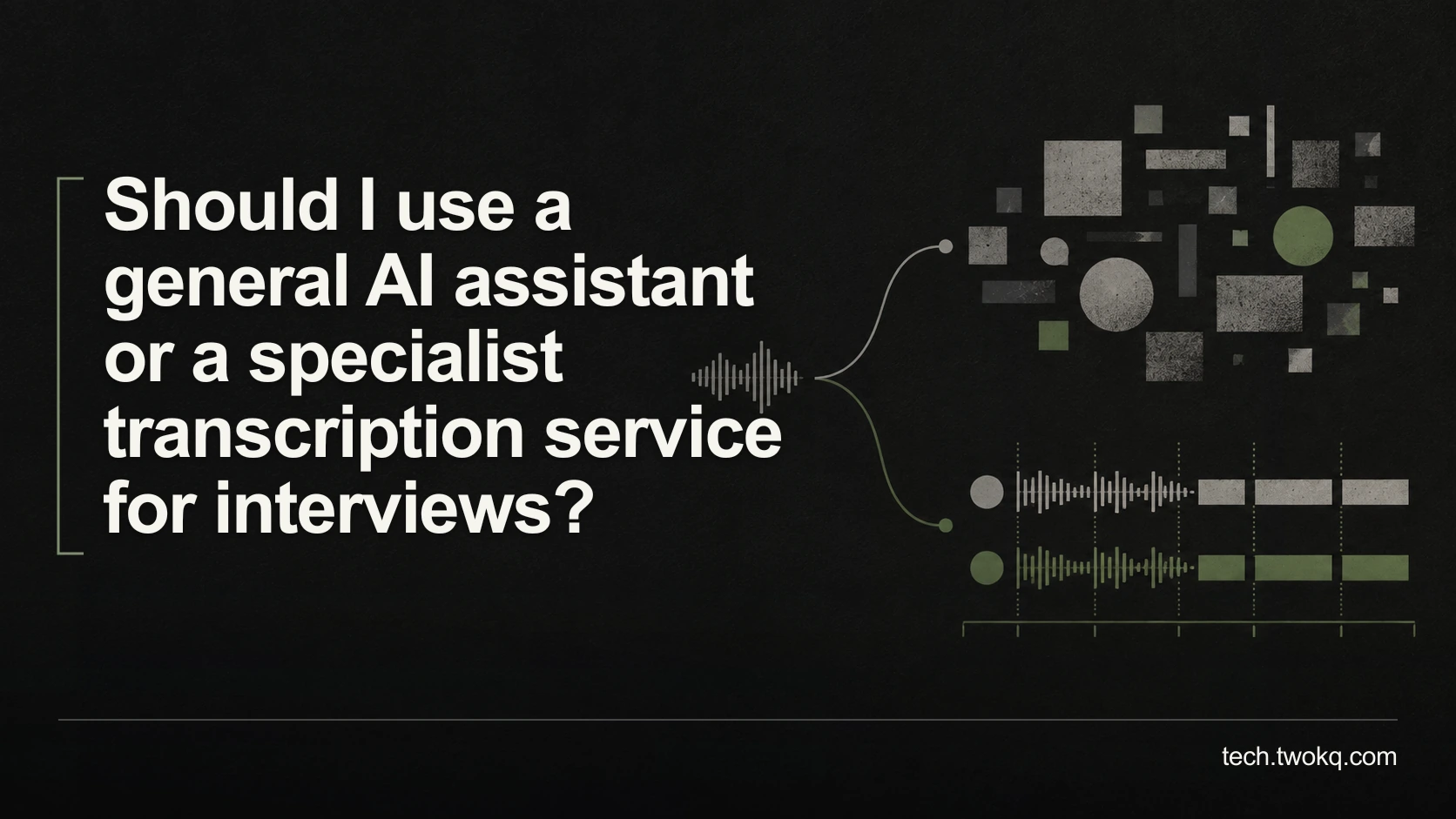
Choose an interview transcription workflow by testing speaker labels, timecodes, corrections, export and privacy against the transcript you actually need.
Direct answer: Choose a transcription-focused workflow when you need a transcript that you can check against audio, correct by speaker and export with usable timecodes. A general AI assistant is sufficient only if its documented input support and actual output meet those requirements without extensive reconstruction. Before buying either, check whether an existing subscription already provides an acceptable transcription feature and whether you have permission to send the recording there.
The deciding factor is not whether the product calls itself specialist. It is whether you can turn its first output into an accurate, attributable record. A fluent interview summary and a faithful transcript are different deliverables.
I would pay for easier correction before paying for more polished summaries. That recommendation changes if you only need private topic notes, have no reason to preserve quotations and can achieve that limited purpose with a simpler approved process.
Applies to: recorded interviews where you are authorised to process the audio. Product availability depends on language, account and platform; the example capabilities below are documented, not independently tested.
Start with the transcript deliverable test
The transcript deliverable test is an editorial method for judging the finished record rather than the initial demonstration. Write a short acceptance statement before comparing services: who will use the transcript, how exact it must be and what must remain traceable to the recording.
For an oral-history interview, your statement might require identifiable speaker turns, timecodes that lead to the relevant audio, a way to flag uncertain words and an editable export. A journalist might additionally need reliable quotation checking. A private study note might require much less.
Specify whether you want verbatim speech, lightly cleaned wording or an edited summary. Removing hesitation can improve readability but may change how a person's certainty appears. Keep editorial changes separate from transcription corrections so another reader can understand what happened.
This is a narrower application of choosing the right AI tool: buy the ability to produce your required deliverable, not a persuasive account of how intelligent the system is.
Establish permission before uploading
Before a trial, identify the recording owner, participant agreement and intended processing arrangements. For a UK oral-history project, the Oral History Society advises discussing purpose and use with participants and establishing the relevant agreement. Access to a recording does not itself establish permission to give it to another service or publish its contents. Requirements vary by country, sector and contract; ask the project lead or a qualified local adviser when the proposed use is unclear. Oral History Society: first approaches.
Inspect the candidate's current terms for audio storage, processing providers, access, retention and deletion. Check the exact account you would use. A personal account's terms are not evidence for an organisational contract, or vice versa.
Use a short recording made specifically for the trial with willing participants and non-sensitive speech. Do not use a confidential interview merely because it is the most realistic file available. Keep an untouched original recording in an approved location; experiment with a copy.
Compare the features that shorten correction
Judge candidates against the same recording and the same required output. The table describes requirements to verify, not promises that every product in a category provides them.
| Requirement | Why it changes the decision | What to verify |
|---|---|---|
| Speaker attribution | A correct sentence assigned to the wrong person is still wrong | Correct a mistaken label and inspect later turns |
| Audio-linked timecodes | They reduce searching during verification | Follow a reference and hear the relevant passage |
| Editable transcript | You need a recoverable correction process | Save an uncertain word and reopen it |
| Export | The project must outlast the account | Open an exported copy outside the service |
| Uncertainty handling | Plausible guesses can become false quotations | Check unclear names, numbers and overlapping speech |
Existing software may meet these requirements. Microsoft's documented Transcribe feature separates speakers, supports timestamped playback and lets you edit text and add a transcript to Word. Its documentation distinguishes platform and subscription availability; check your specific account before treating it as an included option. Recordings are stored in OneDrive, which must be acceptable for your project. Microsoft Transcribe documentation.
Do not infer that a general assistant lacks these features or that a specialist necessarily has them. Verify the exact service. Conversely, an application that accepts audio does not automatically provide a correction interface, exportable timestamps or dependable speaker attribution.
Run a correction-focused sample
Choose a permitted excerpt containing a change of speaker, a proper name, a number and one naturally awkward passage. Keep a small manually checked reference for those details. You are testing the work you will have to do, not trying to create a universal accuracy ranking.
- Submit the same excerpt to each approved candidate, using its documented transcription workflow rather than a summarisation instruction.
- Listen while comparing the text. Mark wrong words, missing speech and incorrect speaker assignments separately.
- Correct those issues and record the time spent locating and editing them. Include time spent learning the interface.
- Export the corrected result and reopen it elsewhere. Check whether speaker labels, time references and uncertainty markers remain useful.
Success means you can produce the required record without guessing or rebuilding missing structure. If the transcript silently replaces unclear speech with a confident sentence, return to the audio. If you cannot resolve it, mark the uncertainty instead of asking the system to invent certainty.
The Oral History Society cautions that AI-produced initial transcripts need checking against the recording. That guidance supports treating transcription as a draft stage, not as an already verified record. Oral History Society FAQs.
Calculate finished-record effort
Consider an illustrative oral-history volunteer processing three interviews of 38 minutes each: 3 × 38 = 114 minutes of audio. None of the following timings are measured results or vendor benchmarks.
Assume a general assistant requires 12 minutes of setup, 114 minutes for listening checks, 18 minutes for speaker-label repair and nine minutes for export clean-up. Total effort is 12 + 114 + 18 + 9 = 153 minutes.
Assume a transcription-focused candidate needs 20 minutes of setup, the same 114 minutes of listening checks, six minutes of label correction and three minutes of export work. Total effort is 20 + 114 + 6 + 3 = 143 minutes.
The second route releases ten minutes across this batch, not 114 minutes and not an automatic cash saving. A specialist interface may be worthwhile for traceability even when the time difference is small. It may not justify another subscription for three recordings if an existing tool exports an equally usable record.
Keep waiting time separate from attention. A ten-minute server delay during which you do other work is not the same burden as ten minutes spent correcting names. Repeat the calculation with your own permitted sample before extending the estimate to an entire archive.
Make a limited decision this week
- Today, spend fifteen minutes defining the transcript standard and confirming the permitted processing arrangement.
- Prepare a five-minute non-sensitive excerpt and a checked reference for its difficult details.
- During one working session, try an existing option and at most one alternative. Record correction effort and inspect their exports.
- Select the least complicated option that meets the standard, then verify one complete interview before committing the whole collection.
Stop if permissions are unresolved, important words cannot be verified or the exported transcript loses essential attribution. For consequential quotations, unclear audio may require asking the speaker, using a qualified transcriber or leaving the passage unpublished. Better software cannot reconstruct evidence that was never captured.
Related guides
Frequently asked questions
Is a summary enough if I am not publishing quotations?
It can be enough when your genuine purpose is finding topics or remembering a discussion, but label it as a summary rather than a transcript. Decide which omissions would matter before using it. A summary may leave out a qualification, disagreement or unresolved question that is essential to a later decision. Keep the recording only under the agreed retention arrangement and verify consequential points against it. If your purpose changes to quoting or attributing a claim, return to the original evidence instead of treating the earlier summary as a substitute record.
Should I choose the service with the lowest advertised transcription price?
Only if the complete approved workflow also meets your requirements. A lower initial charge may be offset by repairing speaker labels, finding quotations manually or rebuilding an export. Compare equivalent audio duration, language support and output needs, and establish whether charges cover failed uploads or additional processing. Do not buy a large allowance before testing a small authorised sample. If your existing software produces a usable transcript, its incremental cost may be lower even when a separate provider advertises a cheaper standalone rate. Your correction time still belongs in the comparison.
Can I delete the recording after creating the transcript?
Follow the project's agreed retention rules rather than deleting it simply because text now exists. A transcript cannot preserve every aspect of tone, timing or context, and you may need the original to verify corrections. Conversely, retaining audio indefinitely can be inappropriate if the agreed purpose does not justify it. Decide retention before collecting or uploading recordings, including who can authorise deletion and where copies exist. If there is a legal, contractual or archival obligation, ask the responsible person before changing it. Deleting one local copy does not establish deletion from a provider's systems.
How should I handle accents or specialist terminology?
Include representative, permitted material in your sample and create a reference list of names and terms you can independently verify. Do not assume a system's broad language support guarantees reliable treatment of every accent, dialect or specialist discussion. Count meaning-changing substitutions separately from harmless punctuation differences. A glossary may help where the product supports one, but the corrected output still needs listening checks. If a word remains unclear, mark it as uncertain and seek the speaker's clarification where appropriate. Guessing a plausible technical term can be worse than leaving an explicit gap.
Is speaker separation the same as knowing who is speaking?
No. Separating voices into speaker labels does not by itself establish real identities, and labels can still be assigned incorrectly. Confirm identities from your authorised recording context and check transitions, especially where people interrupt or sound similar. When replacing a generic label with a name, inspect more than its first occurrence before applying that change throughout the transcript. For anonymous participants, preserve the agreed identifiers rather than adding personal information for convenience. If the source does not let you establish who spoke, retain that uncertainty instead of presenting attribution as a verified fact.
Should I use human transcription instead of AI?
Choose qualified human help when the consequences, audio difficulty or project standard exceed what you can reliably verify yourself. AI can provide an economical first draft, but that does not remove the need for judgement about ambiguous speech and attribution. Compare the human service's scope too: whether it includes checking, timecodes, confidentiality arrangements and a defined transcription convention. A human label is not a substitute for a clear brief or quality review. For a small straightforward recording you can check yourself, an approved automated draft may remain the proportionate choice.
Sources and verification
- Microsoft: Transcribe your recordings, checked 11 September 2026 for documented speaker separation, correction, timecodes, export and storage. No hands-on performance claim is made.
- Oral History Society: FAQs, checked for guidance on reviewing automated transcripts against recordings.
- Oral History Society: legal and ethical first approaches, checked for participant agreements and planned use in UK oral-history work.
- The parent was read from local publication files. Its public URL was not retrievable during verification; the supplied internal paths are retained without independently asserting live status.
This article is practical guidance. Apply it in proportion to your tools, evidence, risks, and responsibilities.