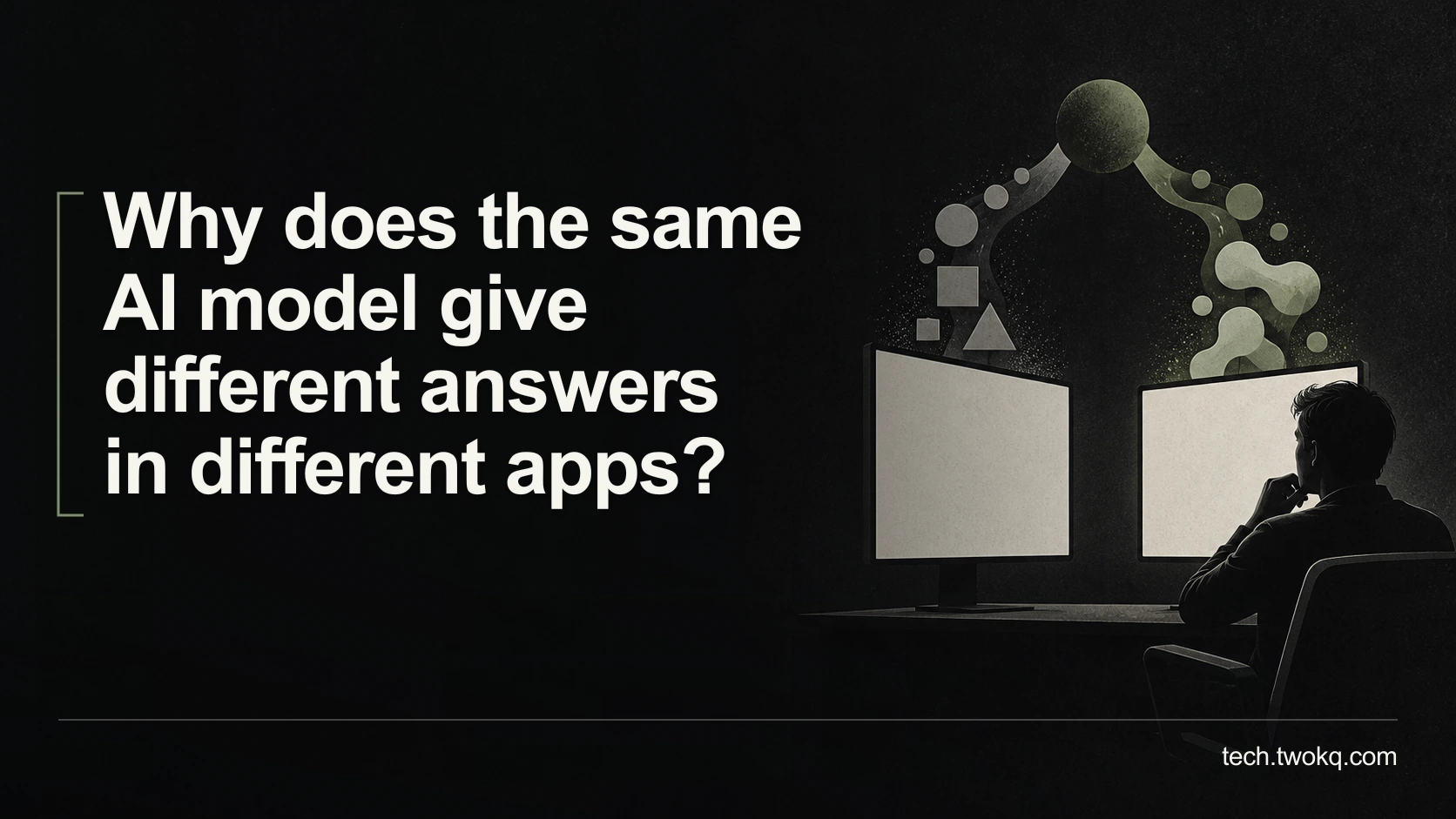
Compare AI apps by checking model identity, instructions, supplied context, tool access and output limits before deciding why apparently identical models disagree.
Direct answer: A model name does not establish that two applications send the same instructions, context or tool results to that model, or even use the same exact version and configuration. Compare the documented model identity, available evidence, application settings and output restrictions before attributing a difference to the model itself. Choose the application that completes your task with verifiable results; unexplained disagreement is a reason to check the answer, not a reason to trust whichever response sounds more confident.
The model generates an output from what it receives. The application controls much of that input and what happens around the response. Your visible question can therefore be identical while the actual circumstances differ.
The parent guide to choosing the right AI tool recommends evaluating useful work rather than a demonstration. Here, use the application layer comparison, an editorial diagnostic method that separates observable product differences from assumptions about the underlying model.
Applies to: comparing two AI applications or access routes. This article describes a documentation-based method and a hypothetical comparison, not a test of named services.
Confirm what “the same model” actually means
Record the name displayed by each application and its supporting documentation. Look for an exact version or a statement explaining how model selection works. A broad family name, a promotional badge or a chatbot describing itself does not establish an identical configuration.
Ask the provider for clarification when identity matters. It may not disclose every implementation detail. Record that limitation instead of guessing that the application is misleading users or secretly switching models.
Also note the date, account tier and selected mode. A saved comparison made before a product change may not describe today's service. Do not infer a specific change from one different answer; obtain evidence from release notes, account information or support where possible.
If exact equivalence cannot be established, describe the exercise as an application comparison. That is still useful. You are buying or using the whole application, including its limitations and workflow, rather than an isolated model label.
Inspect instructions outside the visible question
Applications can provide additional instructions governing tone, task scope or output format. Google's Gemini API documentation documents system instructions and configurable generation settings. This establishes that an application can influence behaviour beyond the user's message; it does not identify what a particular third-party application sends.
Check user-visible preferences, project settings and saved task instructions that you are authorised to inspect. An instruction to be concise can explain a shorter answer without establishing weaker knowledge. A requirement to use only supplied material can explain why an application declines to answer a current question.
For a fair trial, align the settings you can control and record those you cannot. Do not try to extract private system instructions or bypass service restrictions. Documentation and observed behaviour are enough to identify the practical limits of the comparison.
Keep desired behaviour separate from correctness. A friendly response and a formal response may make the same supported claim. Count that as a style difference unless it changes the reader's decision.
Trace the information each application receives
Compare the source material, conversation history and connected information available to each route. If one app has the current document and the other only a short pasted extract, their answers are not based on equivalent evidence.
Google's Gemini Apps Privacy Hub describes information from chats, uploads and connected applications. That is one documented example of an application receiving context beyond a standalone question. It is not a statement that every Gemini session uses every possible source.
For diagnosis, start with a fresh, self-contained task using synthetic information. Supply the same short source to both applications and state what the answer must use. Confirm the source actually arrived and was readable; an attachment appearing in the interface is not proof that every element was interpreted.
Avoid connecting additional personal or work accounts solely to make a comparison more elaborate. Check permissions and data terms before submitting material. You can usually isolate the issue with a small fictional example.
Separate tools from generated knowledge
A tool is an additional capability the application can invoke, such as searching the web, reading a file or running a calculation. If one route retrieves current evidence and another cannot, the output difference may reflect access rather than the model's underlying ability.
Inspect the application's documented capabilities and any source links or execution results it presents. Do not assume a confident statement that it searched proves a search occurred. Open the cited page and check whether it supports the actual claim.
For numerical tasks, reproduce the calculation independently. For current facts, identify the relevant date and original source. An app with more tools can still use them badly, so tool availability is not an accuracy guarantee.
| Difference to examine | Evidence you can collect | What it does not prove |
|---|---|---|
| Model identity | Displayed selection and current provider documentation | Identical hidden configuration |
| Instructions | Your saved preferences and task requirements | Every instruction sent by the application |
| Context | Supplied files, excerpts and permitted connections | That all material was processed correctly |
| Tools | Documented access and inspectable results | That the final interpretation is correct |
| Output limits | Account restrictions and visible truncation | Why every short answer was produced |
Use paired questions without inventing a ranking
Create questions that separately exercise supplied facts, current evidence and formatting. Write the expected result or verification source before submitting them. Keep the exact input and each response so you can inspect differences later.
Suppose an analyst prepares nine synthetic questions and submits each to two apps. That produces 9 × 2 = 18 responses, arranged as nine pairs. All outcomes below are illustrative assumptions, not observations from a product test.
Four pairs differ because only one route had the required tool access. Three differ because the supplied context was not equivalent. Two remain unexplained after the analyst checks the available documentation and settings.
The identified access or context differences account for 4 + 3 = 7 pairs, or 7 ÷ 9 × 100 = 77.8%, rounded to one decimal place. That figure describes this fictional classification, not an accuracy score or a general explanation of chatbot disagreement.
The remaining 2 ÷ 9 × 100 = 22.2% cannot be assigned to a model defect simply because other causes were not found. The configuration may remain partly unknown. Mark the cause unresolved and verify the substantive answer separately.
Now rerun only the comparisons whose inputs you can make equivalent, using new synthetic examples as well. Do not keep repeating a preferred question until the weaker result disappears. Your aim is to find a usable route and its limits, not to manufacture a winner.
Choose the complete application for the job
My recommendation is to compare applications on completed, checked tasks rather than paying extra because one advertises a familiar model. A less elaborate interface can be the better choice when its evidence, export and review process are clearer.
The strongest case for choosing by exact model is a controlled workflow where you can establish the configuration and have evidence that the model's capabilities matter. Most everyday users do not have that level of control. For them, access, reliability, permissions and usable output are part of the product.
Include the time spent preparing equivalent inputs and checking unexplained differences. If another app requires repeated repair or loses source references during export, that affects its value even when the underlying model is capable.
Keep important work independent of a single comparison result. A change in account tier, model version or tool connection can change the behaviour you evaluated. Retain a small representative check for the task instead of assuming the relationship remains fixed.
Investigate the next disagreement in one session
- Spend ten minutes recording both applications, accounts, selected modes and the exact question that produced the disagreement.
- Check model documentation, visible instructions and available evidence. Use a short synthetic source to align the parts you control.
- Allow twenty minutes for a few paired examples and independent verification of the substantive answers. Classify differences by observed cause, leaving unknowns explicit.
- Select the route that produces a usable checked result, or seek support when a required capability remains unclear. Stop comparing when neither answer can be verified from adequate evidence.
Related guides
Frequently asked questions
Can I ask the chatbot which model it is using?
You can ask, but do not treat the generated response as authoritative configuration evidence. Use the application's model selector, current documentation or support information where available. A model may describe a general identity without revealing the exact version or access route used for the request. If the provider does not disclose enough detail, record that limitation and compare the applications as products. You can still judge whether the output helps your task. Avoid drawing an accusation of deception solely from a chatbot's inconsistent self-description; first obtain the information the provider actually publishes.
Does a longer answer mean the application is using a better model?
No. Length can reflect instructions, output limits, task interpretation or the amount of supplied context. Judge whether the answer includes the evidence and qualifications needed for the decision, not how much text it produces. A short answer can be sufficient, while a long one can contain unsupported detail. If brevity is hiding something important, ask a specific follow-up and inspect the result. The comparison changes only when the application repeatedly cannot provide a necessary, verifiable part of the task under the conditions you can establish, not merely because its default style is concise.
Should I pay for both applications to compare them fairly?
Only if paid access is necessary for the actual decision and you can justify the trial cost. Start with documentation and permitted existing access. If free and paid tiers expose different relevant capabilities, record that difference rather than pretending they are equivalent. A purchase should answer a specific unresolved question, with a defined test and cancellation decision. Do not buy two subscriptions merely to reproduce a model-name comparison. If one application already completes your task adequately, the expected benefit of another test should be clear enough to justify both the fee and the review effort.
Why does one application refuse a question another answers?
The services may apply different rules, instructions, capabilities or account restrictions. A refusal is not automatically evidence that the underlying model lacks knowledge, and an answer elsewhere is not proof that the action is appropriate. Check the service's documented scope and clarify the legitimate task plainly if needed. Do not disguise the request or attempt to bypass protections. If a permitted task is unsupported, use an authorised alternative or manual method. In your comparison, record the practical restriction separately from factual errors so the result reflects the kind of work each application can legitimately support.
Can I make two applications identical by copying the same prompt?
No. The visible prompt is only part of the circumstances. You may still have different system instructions, source processing, tools, account limits or model versions. Copying the prompt is a useful starting control, but it does not establish full equivalence. Align the settings and material you are authorised to control, then document the remaining unknowns. For a practical buying decision, complete equivalence is often unnecessary: you need to know which application finishes the task reliably enough. Describe the comparison honestly rather than claiming an isolated model experiment from ordinary chat use.
What should I report when an application repeatedly gives unsupported answers?
Provide the smallest non-sensitive example that demonstrates the problem, along with the application, account type, selected mode, date and expected evidence. Include the actual response and the authoritative source that contradicts or fails to support it. Remove private information before using the provider's approved support channel. Avoid claiming a hidden cause you cannot establish. Explain the effect on your task, such as a missing qualification or incorrect calculation. Meanwhile, keep the affected work under an appropriate verification process or use another route; a submitted support report does not itself make the output dependable.
Sources and verification
- Google: Gemini API text generation, checked 11 September 2026 for system instructions and configurable generation settings. No hidden third-party configuration is asserted.
- Google: Gemini Apps Privacy Hub, checked 11 September 2026 for documented categories of contextual information. Source-derived claims remain limited to the distinctions cited.
- The nine-pair example is hypothetical. The parent was read in supplied project content; its specified public URL could not be retrieved, so supplied internal paths are retained.
This article is practical guidance. Apply it in proportion to your tools, evidence, risks, and responsibilities.