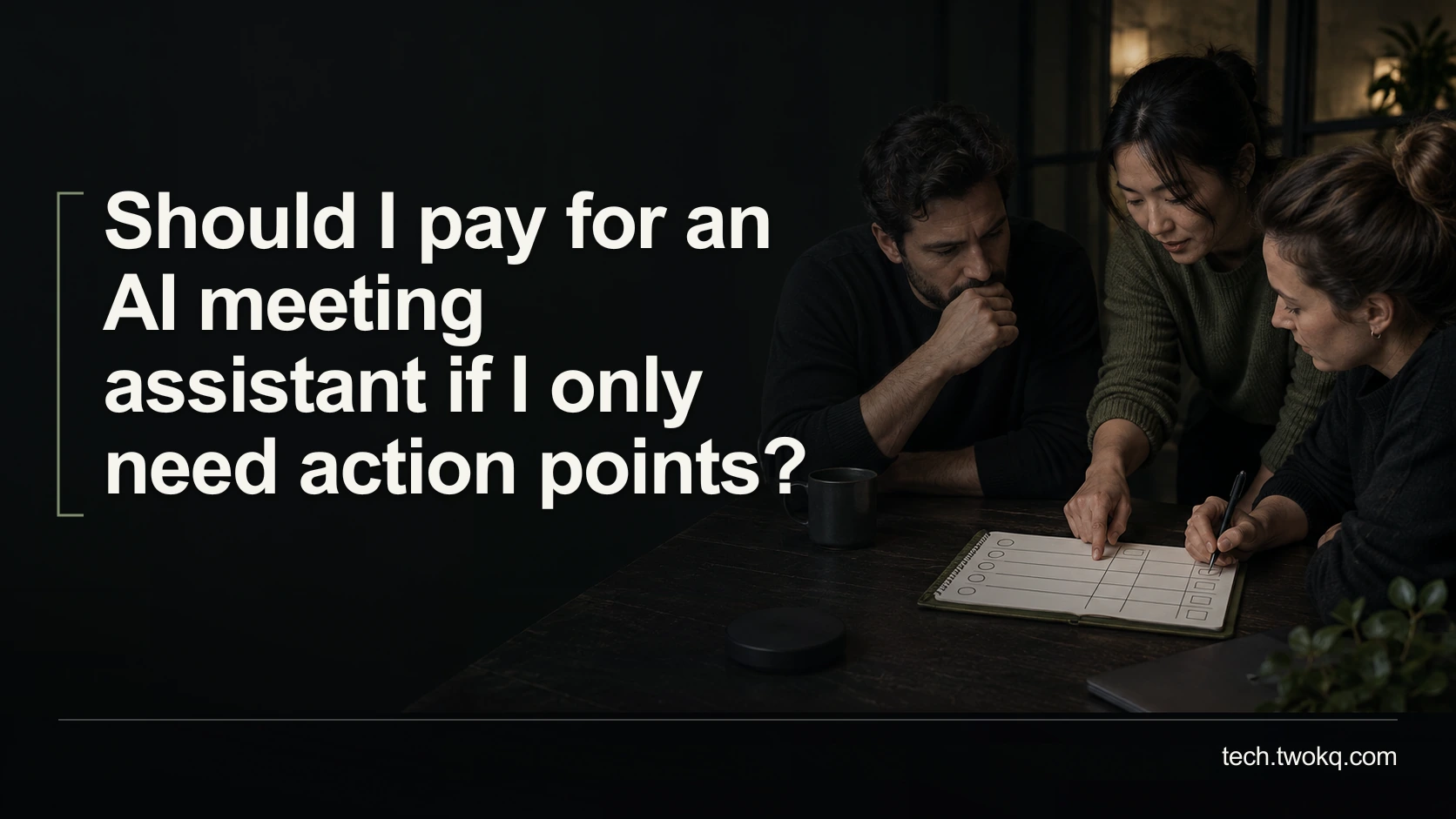
Decide whether an AI meeting assistant is necessary by comparing confirmed actions, ownership, review effort and recording risks with simple shared notes.
Direct answer: Usually not: start with a shared action log that records the agreed task, owner, deadline and any dependency, then confirm it before the meeting ends. Pay for an AI meeting assistant only if a permitted trial shows that it improves this specific outcome after review and administration. If participants need a transcript for accessibility or another justified purpose, assess that additional requirement separately rather than assuming action points alone justify recording everyone.
An action point is an agreement about future work, not merely a sentence containing a verb. Someone suggesting an idea has not necessarily accepted responsibility for it. Recording more speech does not settle that distinction.
My default is to improve the meeting's decision process before adding a recording service. The strongest case for an assistant is a genuine capture problem that persists despite that improvement, with clear permission, useful correction controls and an accountable reviewer.
Applies to: small project meetings where the required output is a reliable action list. UK data-protection context is discussed briefly; obligations vary by country, sector and contract.
Define the meeting-output minimum
The meeting-output minimum is an editorial method for deciding what record you actually need. Begin with the smallest record that lets somebody complete the agreed work and another person check its status.
For each action, capture a verb and deliverable, the person who accepts it, the due date or decision point, and any condition that must be met first. Keep unresolved proposals in a separate section. A blank owner should remain visibly unassigned, not be filled with whoever happened to speak most recently.
For example, “Explore venue options” is too loose if the next decision needs a shortlist. “Ravi will send two available venue options before Friday's budget discussion, subject to receiving the attendance estimate” is actionable. The wording is fictional, but the distinction is practical: it records both responsibility and a prerequisite.
The guide to choosing an AI tool asks whether the tool fits the work. Your narrower question is whether a recording and transcription process is necessary to create this small agreed record.
Try confirmation before automation
Before the meeting, create an empty action section in the existing shared document. Identify who will maintain it and whether participants can access it using their usual assistive technology. Do not buy a new workspace just to host a short list.
During each decision, write the proposed action where participants can inspect it. Ask the named owner to confirm the deliverable and date. If a date is not known, record the condition for setting it rather than inventing one.
Reserve the final few minutes for checking the list. Read it aloud if that helps participants, and offer a way to correct misunderstandings afterwards. This is not an argument that everyone should multitask and type notes throughout a discussion; one nominated recorder or an agreed rotation can keep the process manageable.
Success is a list whose owners recognise their commitments. If tasks still disappear, determine whether capture, agreement or follow-through is failing. A perfect transcript will not make an unaccepted task owned, nor will it persuade a team to review overdue work.
Decide whether recording is justified before enabling it
An assistant may require audio, a transcript, calendar access or other information. Verify the exact service's inputs, participants' visibility, storage, access and retention before connecting it. Do not assume an action-only output means the provider receives only action points.
The UK Information Commissioner's Office says organisations considering online meeting recording should assess whether it is necessary, consider less intrusive alternatives and explain its purpose and use to attendees. The guidance is marked as under review following the Data (Use and Access) Act. Check the current position with your organisation's responsible adviser before relying on it for a particular deployment. ICO guidance on recording online meetings.
Do not interpret this as a universal claim that consent is the only possible legal basis, or that a notification alone makes processing lawful. Establish the applicable basis, permissions and contractual requirements with the appropriate person. Workplace power relationships and sensitive discussions deserve particular care.
For a trial, use a synthetic meeting about an invented project with willing participants. Keep real customer, employment or health information out of the test. Establish how to stop recording and remove trial material before beginning.
Test decisions, not summary polish
Create a small reference action list that participants agree is correct. Include a conditional action, a rejected suggestion and an explicitly unassigned task. These distinctions test whether the output preserves the meeting's decisions rather than simply collecting plausible work.
Compare the assistant's draft against that reference. Check that each accepted task has the correct owner and deadline, rejected ideas remain rejected, and conditions remain attached. Count invented commitments separately from missing tasks; both can cause trouble, but they need different corrections.
Ask the reviewer to repair the output and record the effort. Then ask the named owners to confirm the corrected list. A result that looks professional but requires replaying most of the meeting may not improve your actual workflow.
Keep distribution manual during the trial. Do not automatically send generated assignments or update a live task system before someone has approved them. If the service cannot support a suitably limited trial, do not widen its authority just to complete the demonstration.
Compare six meetings honestly
Consider a fictional neighbourhood project holding six fortnightly meetings. Assume manual action capture adds four minutes of focused confirmation during each meeting and six minutes of clean-up afterwards. The extra organiser effort is 6 × (4 + 6) = 60 minutes.
For an illustrative assistant workflow, assume 18 minutes of initial setup, five minutes of review per meeting, two minutes of recording administration per meeting and eight minutes resolving one mistaken assignment. Total organiser effort is 18 + (6 × 5) + (6 × 2) + 8 = 68 minutes.
In this example the assistant adds 68 minus 60 = 8 minutes. These are assumptions, not measured results or typical performance. They also do not claim that all meeting participants save four minutes when the organiser changes methods; agreement still needs to happen.
Suppose a later permitted trial reduces review to two minutes per meeting while other assumptions remain. The total becomes 18 + 12 + 12 + 8 = 50 minutes, releasing ten organiser minutes across the period. That may still be too small to justify another subscription or recording process.
Time released is not cash saved unless a real expense falls. Reliability or an accessibility requirement may justify the tool even without a financial saving, but state that reason honestly instead of manufacturing a return on investment.
Make the next two meetings your decision window
- Before the next meeting, spend ten minutes preparing an action log and agreeing who confirms ownership.
- Use it for two meetings and record missing actions, disputed assignments and clean-up time. Do not introduce recording during this baseline.
- If capture remains the problem, check permissions and run one limited, non-sensitive assistant trial against an agreed reference list.
- Adopt the assistant only if its corrected output improves the required result enough to justify its cost and administration. Otherwise retain the simpler log.
Stop the trial if it invents commitments that reviewers cannot reliably detect, if attendees' concerns are unresolved or if the necessary data handling is not approved. If the real failure is nobody accepting or reviewing tasks, change that working agreement first.
Related guides
Frequently asked questions
What if nobody wants to take notes?
Agree responsibility for the small action record rather than assuming an assistant removes it. Somebody still needs to confirm that generated owners, dates and commitments are correct. Rotate the role, have the chair write decisions as they are made, or let task owners enter their own commitments in the shared document. Keep the requirement narrow so it does not become a demand for detailed minutes. If the group refuses even to confirm a short list, the main problem is accountability rather than transcription. Buying a tool is unlikely to resolve that disagreement on its own.
Can I record a meeting without asking because the notes are only for me?
Do not assume a private intention settles permission or data-protection questions. Recording other people and sending their speech to a provider can create obligations beyond keeping personal notes. Check the rules that apply to your jurisdiction, organisation, contract and participants before proceeding, and be transparent about the proposed process. For a specific legal decision, seek qualified local advice. If you cannot establish an acceptable arrangement, use a non-recording method for capturing agreed actions. A feature being technically available in your account does not mean every use of it is appropriate.
Are automatic action points useful for someone who missed the meeting?
They can be useful after an attendee verifies them, but make clear which decisions were agreed and which matters remain open. A person who was absent should not be assigned a new commitment merely because a system inferred their name from the conversation. Ask them to accept the task and deadline through the normal process. Include enough context to explain the action without circulating unnecessary discussion. If the absent person needs to understand a disputed decision, a short verified explanation may help more than a long automatic summary with uncertain attribution.
What about accessibility needs during the meeting?
Treat accessibility as a genuine requirement, not as an afterthought in a cost calculation. Ask participants what they need and assess appropriate options, which may include captions, a transcript, written decisions or another agreed adjustment. Do not presume that everyone benefits from the same feature or that action points replace access to the discussion itself. Verify the selected tool's relevant capabilities and privacy arrangements for the actual account. A recording workflow may be justified for a need beyond action capture, but document that purpose and involve the people affected in choosing the approach.
Should generated actions go straight into our project software?
Keep approval between generation and live assignment until you have established an appropriate, reliable process. A mistaken task can notify colleagues, create a misleading deadline or change a client's expectations before anyone notices. During a trial, review the proposed action, owner, date and dependency in a draft area, then transfer only accepted items. Verify any integration's permissions before connecting the workspace. If the manual transfer is brief, retaining it may be the proportionate safeguard rather than another inefficiency to automate. The useful output is an accepted commitment, not simply a populated task board.
How do I know whether poor action points are the tool's fault?
Compare the output with what participants actually agreed. If the meeting never established an owner or deadline, the tool cannot supply one legitimately. If the agreement was explicit but the draft omits or changes it, investigate the capture or interpretation stage. Keep a short record of those distinctions across a few permitted examples. This avoids blaming transcription for a decision-making problem or excusing repeated invented commitments as unclear meetings. When evidence is missing, ask participants to clarify the action rather than repeatedly prompting the system until it produces an attractive answer.
Sources and verification
- ICO: data-protection principles and online meeting recording, checked 11 September 2026, including its notice that guidance is under review. No individual lawful-basis determination is made here.
- The parent was read from local publication files. Its public URL could not be retrieved during verification; supplied internal links are retained without independently confirming live status. The meeting method and figures are editorial and illustrative.
This article is practical guidance. Apply it in proportion to your tools, evidence, risks, and responsibilities.