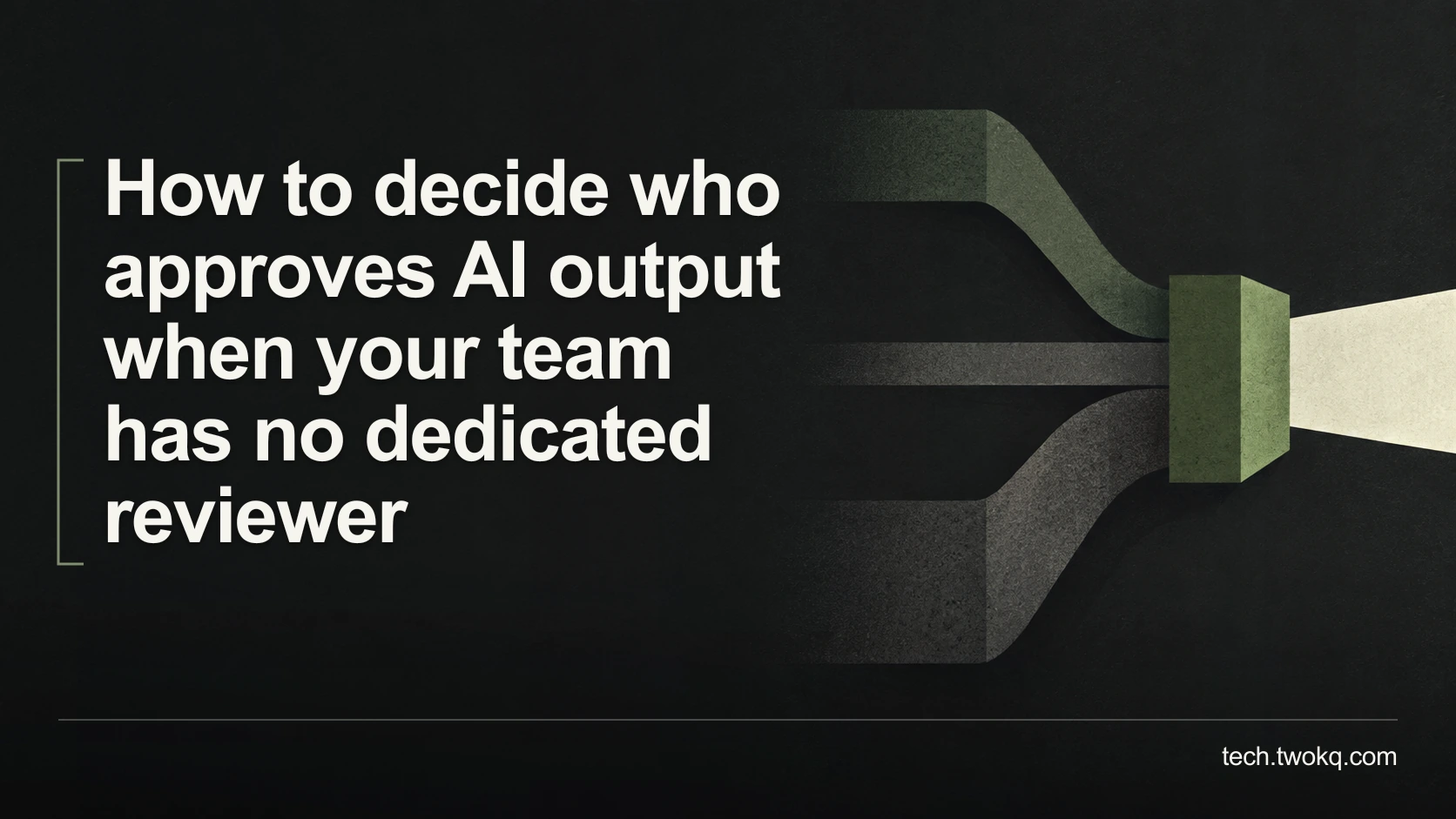
Assign AI review by competence, consequence and available time, with clear approval limits and a fallback when a small team cannot safely check every output.
Direct answer: Assign approval to someone who can verify the particular output against an authoritative source, understands its consequences and has time reserved for the check. That can be the person producing a low-consequence internal draft, but client commitments and consequential decisions need the relevant authorised owner or qualified reviewer. If nobody has the competence or capacity, reduce the AI workload, delay release or use an established process that provides the necessary oversight.
The missing resource is not necessarily a job title. A colleague who knows the source material may make a better reviewer than a manager who only has authority to approve expenditure. Equally, knowing the subject does not automatically give someone permission to commit the organisation.
My recommendation is to make review capacity a limit on production. Generating more drafts than you can check creates a queue of unapproved work, not finished productivity. A different approach can suit reversible personal brainstorming, where ideas remain clearly separate from decisions and external communication.
Applies to: small teams assigning responsibility for ordinary business work, using UK examples. This is an editorial operating method, not legal advice or a replacement for qualified review in regulated work; requirements vary by jurisdiction, sector and contract.
Use the approval capacity assignment
The approval capacity assignment is a practical editorial method: connect each output to a competent checker, an authorised decision owner and an available review slot. One person may fill several roles, but none of those requirements disappears because the team is small.
The UK government's Data and AI Ethics Framework calls for named oversight roles and human responsibility, while recognising that unacceptable risk can justify not using a system. It is public-sector guidance, not a universal private-business approval rule. The narrower assignment method here applies that responsibility question to a small queue of work. Government guidance on human oversight.
For each recurring output, record what it is used for, what a material error would do, who can check it, who can release it and what happens if either person is unavailable. Keep this beside the actual workflow, not in a policy document nobody consults.
This develops the responsibility question in adopting AI without losing trust. It does not require creating a new department before using an assistant to reorganise a harmless working note.
Define the check before choosing the person
Replace “review for accuracy” with the evidence the reviewer must inspect. A meeting summary needs comparison with the approved notes for decisions, owners and deadlines. A delivery email needs the agreed scope, price and date. A calculation needs its inputs, units and independent arithmetic.
Name the failure that blocks release. An invented commitment, unsupported factual assertion or missing qualification is not a cosmetic edit. The checker must be able to return the work or withhold approval without being treated as an obstacle to the promised time saving.
Give reviewers authorised access to the necessary sources. Do not solve an access problem by copying confidential files into a personal account or an unapproved AI service. A reduced test example can help assess the review process without exposing client information.
If a reviewer cannot explain what would make the output wrong, they are not ready to approve it. They may still check spelling or formatting, but that limited contribution must not be recorded as substantive approval.
Match responsibility to consequence
Use the following distinctions as working rules, not official risk classifications. Adjust them to the real consequences and your existing policies.
| Output situation | Suitable check | Release boundary |
|---|---|---|
| Reversible internal draft with accessible sources | Competent author checks the defined facts and labels it as a draft | No external commitment or automatic action |
| Client-facing statement about agreed work | Subject owner checks evidence; authorised owner approves commitments | Send only the approved version |
| Specialist or materially consequential decision | Appropriately qualified review within the established process | Do not substitute a general colleague's confidence |
Independence matters when the same person may overlook an assumption they introduced. It is not a magical property of having a second name in the document. A second person without relevant knowledge can add delay while leaving the original error intact.
For a routine internal summary, informed self-review may be proportionate. For an instruction that changes somebody's access or promises a client a refund, use the organisation's existing authority requirements. AI assistance should not quietly lower them.
Separate checking from release when useful. A subject specialist can confirm technical content while a project owner decides whether the business can make the proposed commitment. Record both decisions if both are necessary; one vague “looks fine” does not establish what was approved.
Work through a 28-output review queue
Consider an illustrative three-person team with 90 review minutes available today: 30 for Alex, 35 for Bea and 25 for Chris. These are planning assumptions, not measured benchmarks or recommended universal review times.
There are 16 routine internal summaries needing two minutes each, eight client updates needing six minutes each, and four specialist outputs estimated to need twelve minutes each. Assume all three colleagues can check the routine material, while Bea and Chris have the knowledge and authority for the client updates. Specialist competence is not available within this group.
The apparent requirement is:
16 × 2 + 8 × 6 + 4 × 12 = 32 + 48 + 48 = 128 minutes.
Allow another ten minutes for handover and ordinary corrections, giving 138 minutes, against 90 available. The shortfall is 48 minutes, but finding extra minutes alone would not provide missing specialist expertise.
The team can allocate the ordinary queue as follows. Alex checks fourteen summaries, using 28 minutes. Bea checks two summaries and four client updates, using 4 + 24 = 28 minutes. Chris checks the other four client updates in 24 minutes. That is 28 + 28 + 24 = 80 minutes, leaving ten across the team for coordination and corrections.
Twenty-four outputs can therefore be considered for release if they pass their checks. The four specialist outputs stay out of the release queue until qualified review is arranged, or the underlying task follows an appropriate established non-AI process. Manual work still needs the relevant competence and authority.
If corrections exceed the remaining ten minutes, fewer items are released. The calculation is a capacity illustration, not a promise that any draft can be approved on a timer. Record actual review effort and failed checks before increasing the next batch.
Make the approval visible on the final version
Use a simple record containing the output identifier, version or timestamp, reviewer, checks completed, unresolved issues and release decision. Include the source references needed to repeat the check, subject to existing access and retention rules.
Approval belongs to a particular version. If somebody changes a price, instruction or qualification afterwards, return the changed material for review. Correcting a typographical error may not need the same process, but agree that boundary rather than assuming every edit is harmless.
Do not automatically send or publish a file merely because a review field exists. The release step must depend on an actual approval decision, and the person operating it should know which version that decision covers.
Record a replacement reviewer for absences only when that person has the necessary competence and authority. Otherwise, the absence means a delay or a different process. An empty review slot is more honest than a nominated substitute who cannot perform the check.
Do not solve overload with superficial checks
A sample can help you understand a batch's recurring defects. It cannot establish that a particular unchecked client commitment is correct. Decide whether sampling is appropriate to the task rather than using it because full review is inconvenient.
Another AI system can flag inconsistencies for a person to investigate. It cannot accept organisational responsibility or supply missing permission. If it cannot access the authoritative source, a confident agreement between systems may still leave the central claim unverified.
When review repeatedly takes longer than producing the work manually, compare the complete workflows. Count preparation, checking, revisions, exceptions and maintenance. Keep AI only where the resulting benefit survives those costs; released time is capacity, not a cash saving unless expenditure actually falls.
Assign the next batch before generating it
- In fifteen minutes, list tomorrow's outputs, their intended use and the evidence each needs.
- Confirm suitable reviewers and their available time before allocating production work.
- Reserve release authority and a fallback for items that fail or cannot be reviewed.
- After the batch, record actual checking time and blocked items, then reduce or expand the next batch on that evidence.
Stop release when competence, source access or approval is missing. Do not turn a staffing problem into permission to send unverified work.
Related guides
Frequently asked questions
Does every AI-assisted sentence need a second person to approve it?
No. Treating every spelling correction like a consequential decision can make review so burdensome that people avoid it. Focus on what the output changes and the evidence needed to verify that change. A competent author may check a reversible internal draft, provided it cannot be mistaken for an approved commitment. Existing policies or contracts may require a second reviewer for particular work, however. Keep those requirements even if the AI contribution seems small. The meaningful distinction is consequence and authority, not a word count or an arbitrary percentage of machine-written text.
Can the most senior person be the reviewer for everything?
Not usefully, unless they have the relevant knowledge and time for every check. Seniority may provide decision authority without the ability to verify a technical claim, an account setting or a specialist calculation. Ask what sources they can inspect and which errors they would recognise. They can remain accountable for arranging appropriate review without personally performing every part of it. If nobody else is available, narrow or defer the work. A manager's approval should not be used to conceal a gap in competence that remains unresolved after the signature is added.
What should a reviewer do when the source itself is unclear?
Return the uncertainty to the person authorised to resolve it, rather than approving whichever interpretation sounds most plausible. Record the conflicting passages, missing date or unknown assumption so the next person has a bounded question to answer. Where appropriate, a draft can state that the point is unresolved, but it must not present a guess as an agreed fact. Urgency does not make the source clearer. If the uncertainty changes a commitment or consequential instruction, withhold that part of the output until clarification or qualified judgement provides a defensible basis for release.
Should review time count against the promised AI time saving?
Yes. Review is part of producing usable work, not an optional overhead that can be omitted from the comparison. Count source preparation, verification, corrections and the handling of failures alongside generation time. Compare that total with an equivalent manual process at the same quality standard. The AI approach may still release useful capacity, but it may not. Do not value every released minute as money saved unless spending genuinely falls. If the benefit depends on reviewers rushing through checks, the promised improvement is a change in quality or risk, not an established efficiency gain.
How should disagreements between author and reviewer be handled?
Resolve the specific disputed claim against the source, approval policy or qualified decision owner. Avoid asking the AI to vote between two people as though that settles responsibility. Record whether the disagreement concerns evidence, wording or an acceptable business commitment, because each may need a different owner. Keep the output unreleased when the dispute affects its correctness or authority. For a low-consequence wording preference, the authorised editor can decide without prolonged escalation. The process should make substantive disagreement visible while preventing minor style differences from blocking work that already meets its agreed requirements.
What if the team has only one person available today?
Limit work to what that person can competently verify and is authorised to release. They may continue an internal draft or check a straightforward transformation against a reliable source, but they should not absorb specialist responsibilities simply because colleagues are absent. Preserve a clear queue for items requiring another person, and communicate realistic delivery dates. If the work is urgent and consequential, use an established qualified support route rather than lowering the approval standard. Temporary lack of capacity can justify postponement; it does not turn an AI-generated answer into a substitute for missing expertise.
Sources and verification
- UK government: Data and AI Ethics Framework, checked 11 September 2026 for named oversight, responsibility and the option not to use a system. Its public-sector scope is distinguished from the editorial small-team method.
This article is practical guidance. Apply it in proportion to your tools, evidence, risks, and responsibilities.