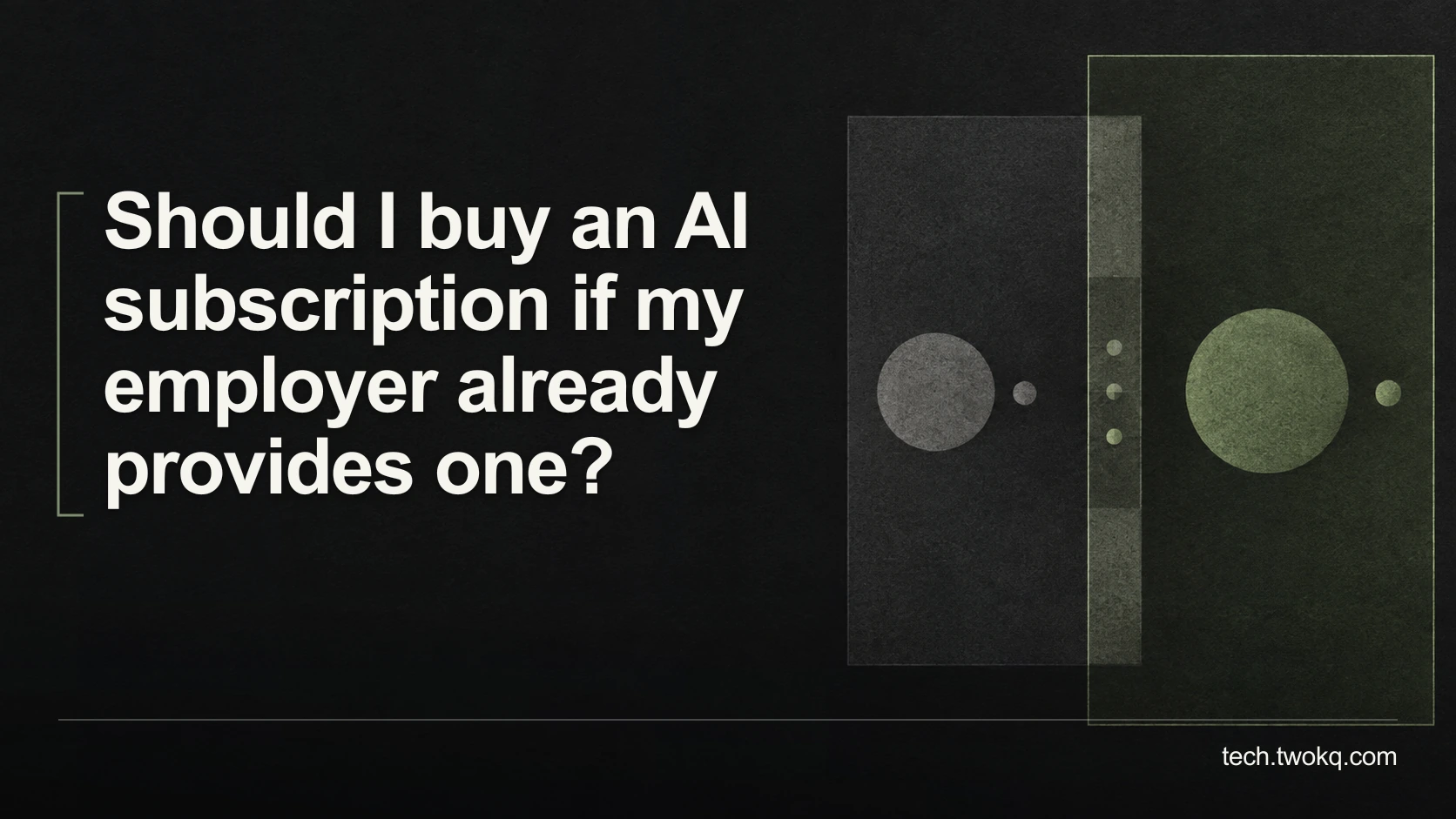
Check whether employer-provided AI covers your needs by separating work permission, personal privacy, account ownership and the cost of paying for separate access.
Direct answer: Do not buy a second subscription until you have checked what your employer's account permits and what your personal tasks actually require. Keep personal material out of a work account unless both the permitted-use rules and the account's privacy arrangements suit it. Buy separate access only when you need independent ownership or a verified capability that your approved existing options cannot provide; occasional personal tasks may still fit a free or manual method.
The apparent duplication is misleading. Two accounts can provide similar text generation while placing their histories, billing and recovery under different owners. A work licence can be useful without being an appropriate home for your private correspondence or a project you intend to keep after leaving the organisation.
The parent guide, How to Choose the Right AI Tool Without Being Sold by the Demo, considers general tool selection. Here, use the entitlement boundary, an editorial method that separates what you can access from what you may use, what you can keep and what you must pay for yourself.
Applies to: employees who already receive access to an AI application through work. Your employer's policy, account arrangement and purchasing region determine the specific answer.
Establish who controls the existing account
Start with the account owner rather than the product name. Record whether your employer supplies a managed account, reimburses an individually owned subscription or merely allows you to use a free service. Those arrangements can have different removal, recovery and purchasing consequences.
Find the written permitted-use policy and the person responsible for the service. Ask whether personal use is allowed, which information can be submitted, whether connected personal accounts are permitted and what happens when employment ends. A colleague saying that everybody uses it is not a reliable account policy.
Provider controls also vary. Google's Workspace privacy documentation describes administrator control over access to Gemini services and supported features. This establishes that access can depend on organisational administration, not that every employer can inspect every conversation. Check the actual visibility and retention rules separately.
If nobody can answer the personal-use question, keep personal tasks outside that account while you clarify it. That does not require an immediate purchase. You can postpone the task or use an appropriate existing non-AI method.
Draw the entitlement boundary around each task
List the actual activities you want help with. “Personal use” could mean drafting a birthday invitation, analysing household spending or developing a freelance client proposal. These do not carry the same confidentiality or ownership requirements.
For each activity, identify the input, expected output, person entitled to see it and required lifespan. An invitation with fictional names may need almost no lasting history. A private project containing financial details may need a personally controlled record and a much more careful provider assessment.
Do the same for work tasks you are tempted to move into your own account. A personal subscription does not grant permission to upload employer information. If a work account has a limit or lacks a feature, request an approved alternative rather than moving documents privately to finish faster.
Keep the two directions distinct: employer permission for personal use and employer permission for work data to leave the approved environment. Resolving one does not resolve the other.
Compare ownership before convenience
| Route | Who must authorise use | What you must establish | Suitable circumstance |
|---|---|---|---|
| Employer-managed account | Employer and applicable provider terms | Personal-use permission, visibility, retention and exit | Permitted low-sensitivity activity without independent-history needs |
| Personal free account | You, plus any relevant data owner | Capability, current limits and personal-service data terms | Occasional tasks that fit available access |
| Personal paid account | You, plus any relevant data owner | A useful paid capability and continuing cost | Repeated personal work needing independent paid access |
| Existing manual process | Normal rights and permissions still apply | Whether it completes the task adequately | Low-volume work where another account adds little |
My default is to keep substantive personal projects under personal control, even when a workplace permits incidental use. This is an ownership decision, not a claim that a paid consumer account is more private than a managed service.
The strongest case for using permitted work access is a minor task with no sensitive information, no connected personal services and no need to retain the conversation. The strongest case for separation is continuity: you need the material and its organisation to remain available independently of your job.
A separate account can be free. Independence and payment are different choices.
Check what the second subscription would actually add
Identify the exact limit you encounter: an unsupported document, insufficient available usage or a necessary export function. Confirm it against the current documentation for the plan and region, then test a permitted example where a trial is available.
Do not compare an employer's managed service with a consumer plan as though their terms were interchangeable. Google's Gemini Apps Privacy Hub explains consumer-app data collection, controls and retention. Its scope differs from Workspace documentation. Read the policy for the account you will actually use before submitting personal information.
The relevant question is whether a capability improves the finished task after review. A paid response that requires just as much checking may still be useful, but faster generation alone does not establish that the purchase earns its place.
Also inspect what you already own. A document editor, spreadsheet or calendar may solve the personal task directly. Do not turn a question about account boundaries into a search for another product simply because AI was your first idea.
Work through three personal tasks a month
Suppose an employee needs three small personal drafting tasks monthly. Every number here is an illustrative assumption, not a vendor price, observed timing or estimate of typical use.
Assume separate paid access costs £19 per month. The direct annual commitment, if retained for twelve months, is £19 × 12 = £228. At three tasks monthly, that is 3 × 12 = 36 tasks, giving an allocated subscription cost of £228 ÷ 36 = £6.33 per task, rounded to the nearest penny.
That calculation does not prove each task is worth £6.33. It exposes the scale of the purchase. If two tasks can be completed using existing software and only one needs the paid capability, the same fee effectively supports twelve qualifying tasks annually: £228 ÷ 12 = £19 each.
Now assume the employer explicitly permits these non-sensitive tasks and the employee needs no continuing chat history. Additional personal subscription spending is then £0 for the approved route. The organisation may still pay for its licence; zero here describes the employee's additional bill, not a free service overall.
If the employee instead needs privacy or ownership that the work arrangement cannot provide, remove that route from the comparison. Its price no longer settles the decision. Compare personal free access, paid access and completing the qualifying task manually.
Include setup: assume 25 minutes to establish a separate account safely and 10 minutes monthly to maintain useful records and check usage. That is 25 + (12 × 10) = 145 minutes in the first year. The time may be worthwhile for separation, but it should not disappear from the decision because the payment is easier to see.
Plan for changes in employment or access
Store approved final work in the appropriate organisational location rather than relying on a personal chat account. Keep personal output in a personally controlled location only when doing so respects the ownership and confidentiality of its source.
Before leaving a role, ask what may be exported and who owns the relevant content. Do not bulk-download a work conversation history merely because some conversations are personal. Mixed histories make this harder, which is another reason to establish a boundary early.
Check recovery independently of the device. If a personal account depends on a work email address, loss of that mailbox could complicate recovery. Use the provider's documented process to change account details when authorised, preserving access before removing an old recovery method.
If employment or account ownership creates a contractual dispute, seek advice appropriate to your jurisdiction and agreement. This article does not assign intellectual-property rights to a generated output merely because you typed the prompt.
Make the access decision this week
- Spend 15 minutes listing the personal tasks, their sensitivity and how long their records must remain available.
- Within the next working day, obtain the relevant work-use and account-control information from your employer's authorised contact.
- Use one non-sensitive example to check whether an existing permitted option completes the task. Record any specific missing capability.
- Decide whether you need separation, payment, both or neither. If buying, record the actual checkout price, billing interval and renewal date.
Stop using the work account for a personal task if permission, ownership or visibility remains unclear. Continue the task through an appropriate existing route while resolving the missing information.
Related guides
Frequently asked questions
Can my employer see every conversation in a work AI account?
Do not assume either complete visibility or complete privacy. Access can depend on the product, workspace configuration, administrator role, retention tools and organisational arrangements. Ask the service owner for the relevant policy and documentation rather than testing visibility with private material. A colleague being unable to open your chat does not establish what administrators or the provider can access. If the answer matters to the personal task and remains uncertain, keep that information outside the work account. This is a reason to choose a suitable boundary, not evidence that your employer is necessarily reading your messages.
Is a reimbursed personal subscription the same as a managed work licence?
No. Reimbursement explains who pays, but may not establish who controls access, who owns the account or what happens to its history when reimbursement stops. Read the purchasing arrangement and provider terms, then confirm the employer's expectations for work material. A personally controlled account can still be unsuitable for confidential workplace information. Conversely, the organisation may have an approved reimbursement process for a defined use. Keep the permission, ownership and billing questions separate so a receipt does not stand in for the decisions that should have been made before the first upload.
Should I use different browser profiles for work and personal AI?
They can make the intended account easier to recognise, but they do not themselves establish confidentiality or authorisation. Before submitting material, check the account identity, workspace and relevant connection settings in the application. A separate browser profile is a practical organisation aid, not a substitute for suitable device controls or data terms. If your employer manages the computer, its device policy still matters when you use a personal account. Avoid storing private credentials on a device where personal use is restricted. Choose separation arrangements that your actual device and account policies support.
Can I copy useful prompts from work into my personal account?
Only when you have permission to take the material and it contains no restricted information. A prompt can include internal processes, customer details, examples or source excerpts even when it looks like a generic instruction. Review the entire text and any attached files before copying it. If you only need the general technique, create a new prompt using fictional examples and your own requirements instead. Where ownership is uncertain, ask the responsible person. Calling something a prompt rather than a document does not remove the confidentiality or contractual obligations attached to its contents.
What if I need a feature my employer refuses to provide?
Describe the specific work requirement and ask for an authorised way to complete it. The answer might be a different approved tool, a revised process or manual work. Do not treat refusal to purchase a feature as permission to upload work into your personal subscription. If the task is genuinely personal, assess it separately against your own budget and privacy requirements. A suitable purchase should address a verified capability gap, not merely dissatisfaction with the work product. Keep evidence of the limitation so the discussion concerns the actual job and its constraints.
Should I cancel my personal plan immediately after receiving work access?
Wait until you have checked what each account is doing and preserved any records you are entitled to keep. Review the personal plan's renewal and cancellation conditions, then determine whether its qualifying tasks remain. You may be able to cancel without losing something you need, but do not assume work access is an equivalent replacement. If the personal account contains ongoing projects, test an appropriate free or manual continuation first. The sensible decision can be cancellation, a downgrade or retaining separate access; it depends on the boundary and capability checks rather than the presence of a second login.
Sources and verification
- Google Workspace: Generative AI privacy hub, checked 11 September 2026 for organisational access controls and the scope of Workspace documentation.
- Google: Gemini Apps Privacy Hub, checked 11 September 2026 to distinguish consumer-service terms. No employer's visibility or contractual policy was independently inspected.
- The parent guide was read in supplied Twokq Tech project content. Its specified public category URL could not be retrieved; supplied internal paths are retained. All monetary and timing figures are illustrative.
This article is practical guidance. Apply it in proportion to your tools, evidence, risks, and responsibilities.