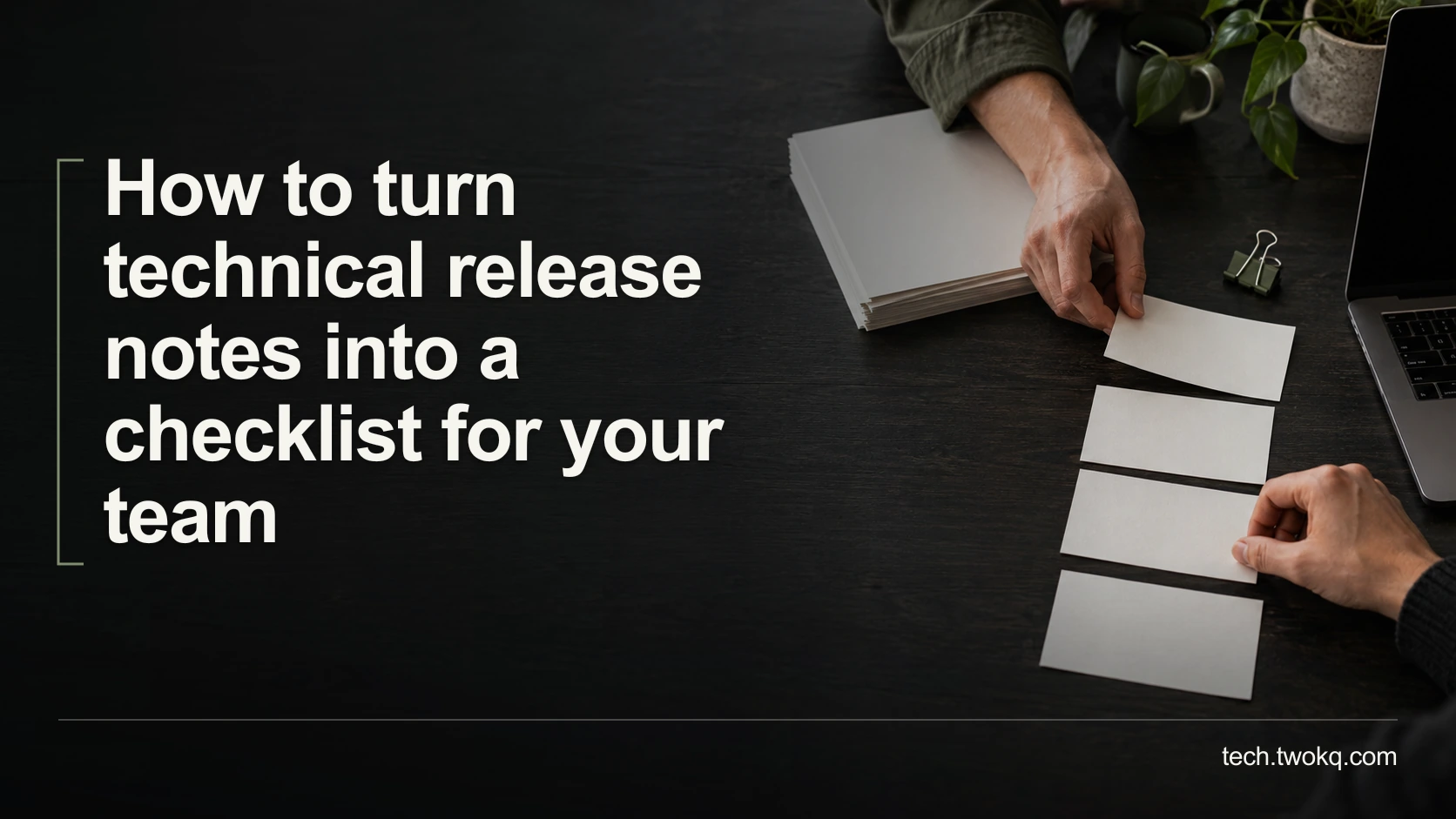
Turn release notes into specific checks for your team's versions and workflows, with source links, assigned owners and a safe way to verify each change.
Direct answer: Match each documented change to a version, account and workflow your team actually uses, then write an observable check with an owner and a source link. Use AI to organise that evidence, not to decide which changes apply or invent configuration instructions. If the release is not available to your account, or the vendor has not explained a migration safely, record an unresolved question instead of an action to change production settings.
A tidy summary can still be useless. “Improved permissions” tells a colleague almost nothing about whether a client can still open a shared folder. Your checklist needs to translate the announcement into a condition you can observe in your own work.
The difficult part is deciding relevance. A long update may contain only one change that matters to you, while a short retirement notice may require several people to act. This is a bounded application of a human-led AI workflow for knowledge work: the useful output is a traceable set of checks, not a shorter press release.
Applies to: small teams reviewing desktop or cloud-software updates. The method is product-neutral and documentation-based, not a report of hands-on testing.
Use the release-impact mapping
The release-impact mapping is an editorial method for joining a vendor's change to your team's evidence. Each row moves from source, to applicability, to affected job, to verification. A row that cannot complete that chain stays unresolved.
Before starting, collect the original announcement, relevant support documentation, your account tier or installed version, and a list of recurring workflows. Ask the person responsible for the software to confirm anything you cannot see. Do not borrow administrator credentials or change permissions merely to make a more complete spreadsheet.
Use these columns in an ordinary document or spreadsheet:
| Column | What belongs there |
|---|---|
| Source | Vendor URL, release identifier and relevant heading |
| Applicability | Account, version, region or rollout condition |
| Affected job | The actual task, such as sending an invoice export |
| Expected result | A visible condition that counts as a pass |
| Owner and timing | Who checks it and before which deadline |
| Evidence and response | Result, unresolved question and safe next action |
My recommendation is to make a shorter checklist with explicit unknowns rather than a comprehensive-looking one filled with inferred actions. For a regulated or business-critical migration, the checklist also needs the relevant specialist's approval. Its neatness cannot substitute for that authority.
Establish whether the update is yours
Separate an announcement date from availability. A feature can be announced before everyone receives it. For example, Microsoft's documentation distinguishes scheduled, rolling-out and launched statuses for applicable Microsoft 365 announcements, and says the organisation-level status is available only for limited Microsoft Teams announcements. Do not assume every update has that field. Microsoft's Message center documentation.
Record what you know: the installed version, the relevant message identifier, or an administrator's confirmation that the change has reached your account. “A colleague saw it elsewhere” is a lead to investigate, not confirmation.
Version numbers also need context. Under Semantic Versioning, a major increment represents an incompatible public API change, but that interpretation applies to software following the specification. A large number in an unrelated desktop app does not establish the same meaning. Semantic Versioning specification.
If you are moving across several releases, check the intervening notes for removals and migration requirements. Reading only the destination release can miss a change introduced earlier. Preserve links to the relevant entries rather than copying whole manuals into the checklist.
Ask AI to organise, not complete, missing facts
Public release notes can normally be supplied without including your internal account information. Your workflow descriptions may still reveal confidential projects or security arrangements. Use generic task names unless the chosen service and account are approved for the real details. Do not attach private admin screenshots or credentials.
An illustrative instruction is:
> Organise the supplied release-note entries into the listed columns. Cite the supplied heading for each change. Separate explicit vendor statements from suggested checks. If account availability, timing or instructions are absent, write “not established”. Do not add settings, commands or migration steps that the sources do not contain.
This instruction has not been tested here and does not guarantee compliance. Review every returned source against the original. Check whether a suggested action was actually documented or merely sounds plausible.
Ask for omitted entries in a separate list with reasons. Otherwise an assistant can discard a technical detail that seems unimportant but affects your export, integration or accessibility requirements. Keep the original notes open beside the draft while you decide.
Convert changes into checks people can perform
A useful check identifies an action and a result. For a fictional change to CSV export, “test exports” is too broad. A better row says: “Export a synthetic invoice using the documented method; open it in our receiving spreadsheet; confirm the invoice identifier stays intact and the total remains in the correct column.”
For a fictional sharing change, specify the intended viewer's access, not just the owner's screen. For a keyboard-navigation change, ask the person who uses that workflow to confirm that the essential task remains possible. Do not infer accessibility from the existence of a button.
Keep verification separate from implementation. Checking an export should not overwrite the live accounting import. Use a test location and synthetic records. Before a change that may alter or remove data, confirm a recoverable copy and the vendor's supported rollback or recovery route. A downgrade is not automatically safe after a file-format migration.
When the result fails, capture the relevant version, exact error and non-sensitive reproduction steps. Ask the vendor or responsible administrator to resolve the mismatch. Do not let AI improvise commands against a live system.
Budget the review before promising savings
Consider an illustrative six-workflow design studio reviewing 15 fictional release-note entries. These figures are planning assumptions, not a product benchmark or observed test.
An initial pass identifies four applicable entries, eight irrelevant entries and three unresolved ones. The totals reconcile: 4 + 8 + 3 = 15. The four checks cover different workflows; the other two workflows have no identified change, not a guarantee of no possible impact.
Assume manual preparation takes 45 minutes. Each applicable rehearsal takes eight minutes, and each unresolved question takes five minutes to investigate. Total manual effort is:
45 + (4 × 8) + (3 × 5) = 92 minutes.
An AI-assisted draft takes 12 minutes to prepare and requires 22 minutes of source review. The same rehearsals and questions still apply:
12 + 22 + 32 + 15 = 81 minutes.
The apparent benefit is 11 minutes, not the full 33-minute drafting reduction. If maintaining the saved instruction and workflow list takes another 15 minutes that month, the first run consumes four minutes more than the manual approach. Later runs might repay that setup, but only if you measure them.
This is released time, not automatically cash saved. A small checklist read directly by the software owner may be the more economical option.
Produce the first checklist in one working session
- Spend the first 15 minutes gathering the source, version or account evidence, and workflow list. Stop if you cannot identify which product or release you are reviewing.
- Draft the mapping and mark unresolved applicability. Use AI only if organising the material is genuinely the slow part.
- Ask each owner to rehearse their check in a safe location. Collect the result and supporting evidence before marking it complete.
- Before the relevant rollout or deadline, decide whether to proceed, request clarification or escalate to the software owner. Record the next review date for changes not yet available.
If safe verification requires permissions, recovery capability or expertise you lack, stop there. An honest unresolved row is more useful than a tick beside an unperformed test.
Related guides
Frequently asked questions
Can I use a vendor's AI-generated release summary directly?
Use it as an index to the underlying material, not as your finished checklist. A vendor summary may correctly explain the headline while omitting a limitation that matters to your plan or integration. Follow each relevant item to the release note or support page, then add your own applicability evidence and expected result. If the summary and detailed documentation disagree, record the conflict and ask for clarification. For a cosmetic change with no operational consequence, reading the original may be sufficient without creating a formal checklist at all.
What if the software updates automatically?
Build checks around detecting and responding to change rather than assuming you can postpone it. Identify the vendor's supported notification route and the account owner who receives it. Keep a small synthetic example of the workflow so you can repeat the essential check after an update. Record a supported fallback where one exists, such as a manual export process. Do not disable security updates as a default response to uncertainty. If an automatic change repeatedly disrupts critical work, raise the operating arrangement with the supplier or your administrator.
Should every colleague read the original release notes?
Not necessarily. One responsible reviewer can retain the source trail while colleagues receive the specific checks relevant to their jobs. They should still be able to open the source if they need context or disagree with the interpretation. This reduces duplicated reading without making the AI summary the only evidence anyone sees. A specialist should review changes affecting their expertise, even if another person prepared the table. For a very small update, sending the original note with a clear question can be simpler than circulating another document.
How do I handle a vague claim such as improved performance?
Treat it as a vendor claim until you can relate it to a defined task. Write down the operation you care about, the conditions under which it runs and an observable measure, such as completion time or successful exports. Compare like-for-like examples if you decide to test it. Do not invent a percentage improvement or ask AI to infer one from the wording. If performance was not a problem for your team, the sensible action may be to record the announcement without spending time constructing a benchmark.
What if a colleague cannot reproduce my result?
Compare the environment before repeating the same instruction. Check product version, account tier, permissions, operating system, file type and whether the change is still rolling out. Use the same synthetic input where practical, then record the difference rather than averaging the results. A successful owner-account test does not prove an invited client has the same access. If the difference remains unexplained, leave both observations in the checklist and escalate with a minimal reproduction. Avoid sharing private account details across the team merely to make troubleshooting quicker.
How long should completed checklists be kept?
Keep them for as long as they support a real operational need, such as explaining a migration, repeating a test or understanding a later failure. Set a review point rather than retaining every draft indefinitely. Preserve the final decision, source identifiers and useful evidence; remove redundant AI drafts and unnecessary personal information under your organisation's retention rules. Contractual or regulated work may require a different approach, so ask the responsible person before deleting records. A checklist should remain understandable without requiring access to one employee's private chat history.
Sources and verification
- Microsoft: Message center, checked 11 September 2026 for release-status scope and rollout distinctions.
- Semantic Versioning 2.0.0, checked 11 September 2026 for the meaning and scope of version increments.
This article is practical guidance. Apply it in proportion to your tools, evidence, risks, and responsibilities.