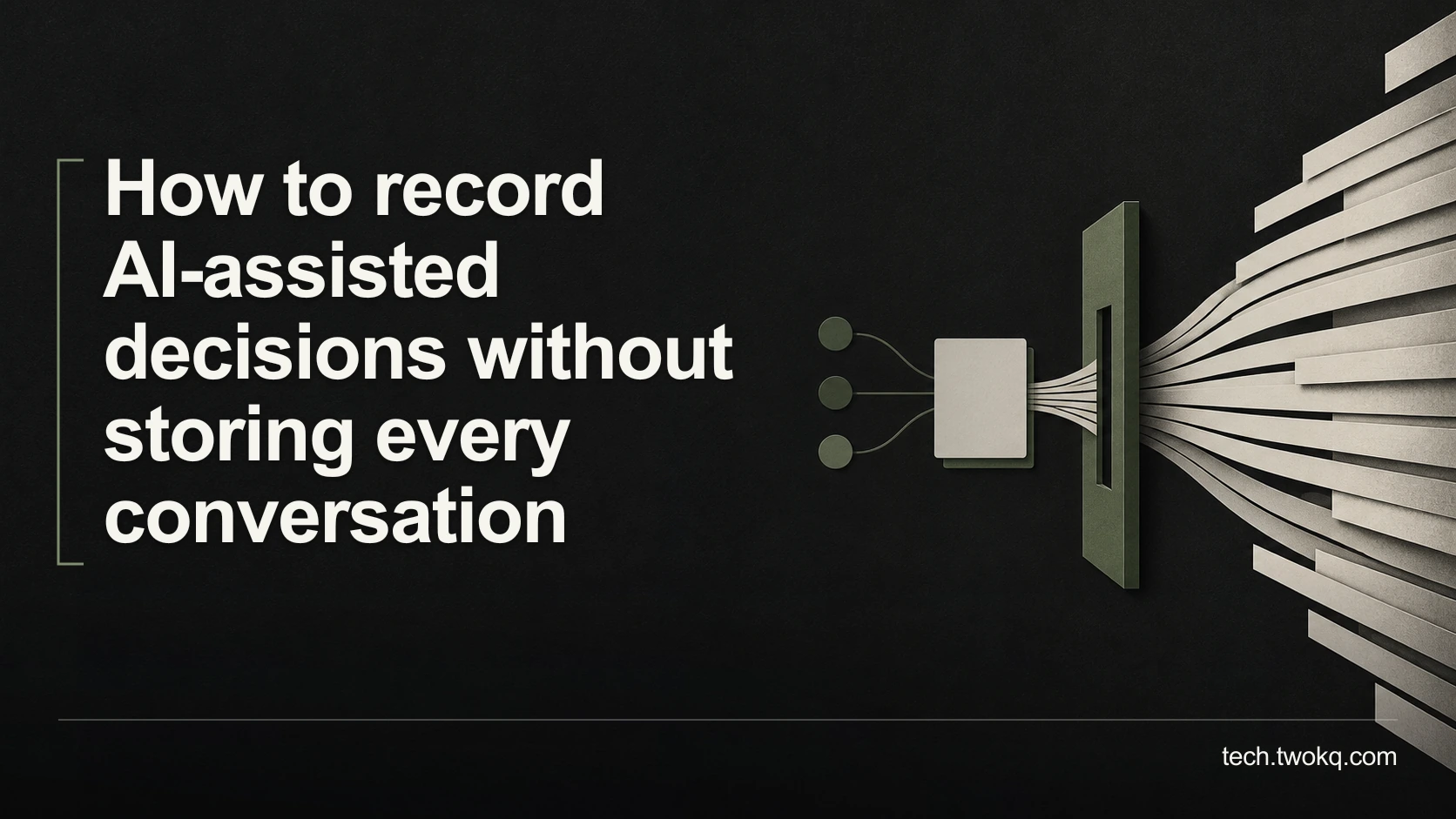
Keep a concise record of AI-assisted decisions with sources, material assumptions, reviewer and outcome, while following the retention rules that apply to your work.
Direct answer: Keep a decision record that states the question, relevant evidence, material assumptions, AI contribution, human reviewer, chosen action and reason. Link to the approved source versions and retain the exact input or output only where it is needed to understand or investigate the decision. Follow the applicable retention policy before deleting conversations; a concise record is not permission to remove material subject to a contractual, legal or organisational requirement.
A long chat can contain exploration, abandoned assumptions and irrelevant personal information while still failing to explain why the team chose an option. Keeping everything is not the same as keeping an intelligible record.
I recommend recording the accepted reasoning in the team's normal working system rather than treating the conversation transcript as the official decision. The exception is a task where reproducibility, investigation or a specific obligation requires the detailed interaction as well.
Applies to: ordinary small-team work with an established owner for records and retention. UK data-protection principles are noted; legal and contractual requirements vary by jurisdiction and sector.
Use the minimum decision evidence record
The minimum decision evidence record is an editorial method for preserving what a later authorised reader needs to understand the action. Minimum means sufficient for the purpose, not as short as possible.
Ask whether someone outside the original conversation could answer: what was decided, based on which evidence, under which conditions and by whom? If those answers are missing, another thousand chat messages will not necessarily supply them clearly.
Record the decision in your existing document, ticket or project record. Do not create a new tool simply to store a small amount of accountable information. Use the system whose access and retention arrangements already fit the work, if one exists.
The guide to AI adoption without losing trust emphasises ownership and visible reasoning. A concise evidence record makes that ownership usable after the person who wrote the prompt has moved on.
Separate the decision from the conversation
Start with the actual decision, not “AI analysed the options”. Write the chosen action and its scope. For example, “Keep the current scheduling process for the next project because the proposed automation's exception review exceeds the available time” describes an accountable judgement.
Name the important alternatives considered and why they were rejected. You do not need every suggested phrase or discarded idea. Include an alternative when understanding its rejection changes how a future reader would reassess the decision.
Identify what AI contributed: organising supplied notes, drafting a comparison, suggesting checks or generating a calculation that a person then verified. Avoid vague statements that imply the model independently validated evidence it merely reformatted.
Record the human reviewer and the actual approval action. A name in a template should not imply review occurred. If a draft is awaiting approval, say so clearly and keep it from being mistaken for an authorised decision.
Keep the conditions that would change the answer
An accepted recommendation may depend on a budget, supported device, account tier, deadline or data-handling restriction. Preserve those material conditions rather than the entire conversational context.
If a particular instruction materially shaped the output, keep that instruction or an accurate versioned reference to it. For a repeatable process, identify the workflow version and the model or application information you can actually establish. Do not invent hidden configuration details to make the record look complete.
Separate supplied facts from assumptions. A verified price quote should have its source and date; an estimated review time should be labelled as an assumption or a recorded observation, whichever it actually is.
Include the uncertainty that remains and the trigger for reassessment. “Review when the required file format changes” is more useful than “review regularly” if compatibility was the deciding condition. Where time matters, assign an actual review date through the team's process.
Link evidence without spreading unnecessary copies
Use the exact approved source version or a stable record location. A link to an editable document without a version may later point to different evidence. Where a permitted snapshot is necessary, store it under the same appropriate controls as the decision.
Check that the people authorised to review the decision can access its supporting material. A concise record with inaccessible evidence is not sufficient merely because it contains links. Conversely, do not broaden source permissions to everyone just to make one record easier to open.
Avoid copying personal details into a decision summary when a controlled reference is enough. The purpose is to preserve reasoning, not to distribute the raw data more widely. For sensitive matters, obtain advice on the appropriate record structure and access restrictions.
Do not ask an unapproved AI service to summarise confidential chat history as a records-management shortcut. That introduces another disclosure before you have decided what should be kept. Draft the short record yourself or use an approved process with suitable handling terms.
Apply retention rules before deleting anything
The UK ICO's storage-limitation guidance says organisations should justify how long personal data is retained according to its purpose and review it when no longer needed. It does not provide a universal time limit for every data type. The page is marked as under review following legislative changes, so consult current guidance and the responsible adviser for your situation. ICO storage-limitation guidance.
Do not turn that principle into an instruction to delete all chats immediately after summarising them. A complaint, investigation, contract or legal hold may require particular material to remain. Check the applicable policy and authority before removal.
Distinguish your team's saved copy from the provider's retained information. Deleting an export or a local note does not establish deletion in the service. Verify the actual provider's controls and terms if that affects the decision.
Set retention and access for both the concise record and any supporting transcript retained as an exception. The two may serve different purposes and require different treatment. Document who can approve changes rather than leaving deletion to individual preference.
Compare eighteen monthly decisions
Consider a fictional project making 18 AI-assisted decisions per month. Assume storing a full chat export for each uses an average 120 KB, while a concise evidence record uses 8 KB before attachments. These are invented planning figures, not measured file sizes.
Full-chat storage would be 18 × 120 KB = 2,160 KB per month. Concise records would be 18 × 8 KB = 144 KB, a difference of 2,160 minus 144 = 2,016 KB. This small example is not a persuasive reason to optimise storage cost; clarity and appropriate information handling matter more.
Now assume three decisions genuinely require their full chat export as supporting evidence. Keeping all 18 concise records plus those three exports uses 144 + (3 × 120) = 504 KB, before source attachments. That is a deliberately selective record, not a claim that smaller storage is legally compliant.
Suppose finding the accepted rationale in a full chat takes an illustrative six minutes, while reading the concise record takes two. Reviewing 18 decisions would take 18 × 6 = 108 minutes versus 18 × 2 = 36 minutes, releasing 72 review minutes under those assumptions.
Include the effort to create the records. If each takes four minutes, preparation is 18 × 4 = 72 minutes, matching that one review's time release. The benefit may be clearer accountability and later reuse, not an immediate net time saving. Replace every assumption with observed figures before making a productivity claim.
Check whether the record is genuinely usable
Ask an authorised colleague who was not in the conversation to explain the decision from the record. They should be able to locate the evidence, distinguish assumptions and identify who approved the action.
If they need the chat for a material detail, either add that detail accurately or retain the relevant supporting interaction under the appropriate policy. Do not expand the record with unrelated conversation simply because it is easier than selecting the important evidence.
Preserve corrections visibly. If the decision changes after new information arrives, create an update that identifies what changed and why. Avoid overwriting the original rationale so completely that nobody can understand the earlier action.
Create the next record in ten minutes
- Write the actual decision, its owner and current approval status before closing the work session.
- Link the source versions, label material assumptions and describe the specific AI contribution.
- Record the reason, rejected alternative and condition that would trigger review. Ask an authorised colleague to check whether the record stands on its own.
- Apply the existing retention policy to chats and supporting material only after confirming any exception or hold.
Stop deletion if you cannot establish the applicable rule or if a material dispute or investigation requires the record. Improve the decision note now while seeking appropriate advice about what must remain.
Related guides
Frequently asked questions
Do we need to save the exact prompt every time?
Not necessarily, but retain it when its wording materially affects interpretation, reproducibility or investigation. A generic request to organise approved notes may need only a description of the transformation. A consequential workflow with strict conditions may require the exact versioned instruction and relevant output. Decide based on the record's purpose and applicable policy, not a universal preference for saving everything or nothing. If you omit the prompt, make sure the decision record still explains the material input conditions. Do not claim a process can be reproduced exactly when the information needed to do so was not retained.
Can an AI-generated summary serve as the official record?
Only after an authorised person checks it against the evidence and confirms that it accurately represents the decision. A summary can omit uncertainty, merge rejected ideas with accepted ones or imply an approval that never occurred. Treat it as a draft, preserve the reviewer and approval status, and correct consequential omissions before relying on it. Use an approved service for the material involved. If the original conversation contains confidential information that the summarising tool is not authorised to process, write the record manually instead of creating a new disclosure to simplify administration.
Is a shorter record automatically better for privacy?
No. A short sentence can still reveal highly sensitive information, while a longer carefully controlled record may be necessary for accountability. Evaluate purpose, content, access and retention together rather than counting words or bytes. Remove unnecessary personal detail where a controlled reference is enough, but do not delete evidence needed under an applicable obligation. A concise record can reduce duplication, yet it does not itself establish anonymisation or lawful processing. For a specific data-protection decision, involve the responsible professional and follow the requirements of the relevant jurisdiction and sector.
What if a source link stops working later?
Your record should identify the source sufficiently to investigate, including title, version or date and the relevant section. Where policy and rights permit, retain an appropriate snapshot of evidence that must remain available. Do not assume an external link will stay unchanged forever. If a link fails, recover the same source where possible and record the replacement address without silently changing the evidence. If the source cannot be established, mark the limitation and reassess any current decision that depends on it. A link is useful, but the record needs meaningful source identity as well.
Who should own the decision record in a very small team?
Assign ownership to the person responsible for the decision or the workflow, with a clear backup if they are unavailable. The role includes ensuring the record is complete, appropriately accessible and reviewed when its conditions change. It does not mean one person must personally write every note. Avoid leaving records scattered across individual chats with no agreed location or retention rule. For consequential matters, separate drafting from approval where practical and obtain appropriate expertise. Small team size is a reason to keep the process simple, not to leave ownership implicit.
Can we delete old conversations once the project ends?
Check the applicable retention schedule, contractual requirements and any legal or investigative hold before deleting them. Project completion does not automatically end every purpose for keeping a record. Equally, an indefinite habit of retaining all conversations may be unnecessary. Identify which material supports decisions, obligations or unresolved issues and follow the authorised process for the rest. Verify whether deletion affects only your copy or also information held by the provider. If the rule is unclear, seek responsible advice rather than making an irreversible deletion because the storage folder looks untidy.
Sources and verification
- ICO: storage limitation, checked 11 September 2026 for purpose-based retention and the current review notice. No universal retention period or case-specific legal conclusion is supplied.
- The parent was read locally after public retrieval failed. Supplied internal paths are retained without independently confirming live publication. The decision-record method and storage and timing figures are illustrative, not tested product results.
This article is practical guidance. Apply it in proportion to your tools, evidence, risks, and responsibilities.